

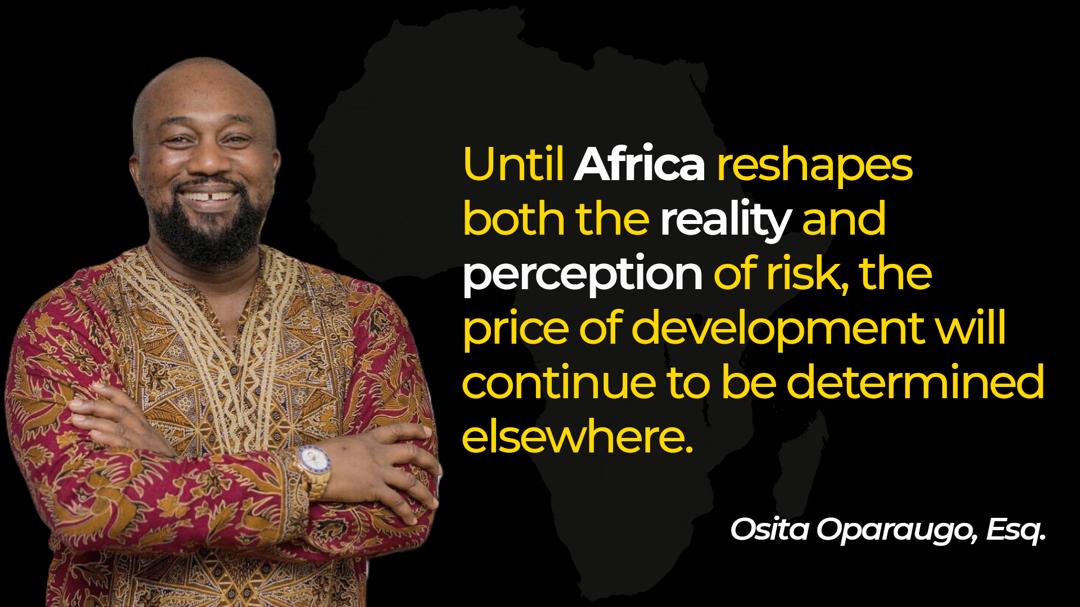
Let’s begin with a simple but important question: Does Africa have a risk problem, or a perception problem?
If you listen to global financial conversations, the answer often seems straightforward. Africa is widely described as risky, too unstable, too uncertain, too complex for serious investment. This narrative echoes across boardrooms, investment committees, and financial reports, shaping how the continent is viewed and, more importantly, how capital flows.
But there is a fundamental flaw in this thinking.
Africa is not a single country. It is a vast and diverse continent of 54 nations, home to over 1.4 billion people, and one of the youngest, fastest-growing populations in the world. Within its borders, economies are improving governance, expanding infrastructure, fostering entrepreneurship, and nurturing a growing middle class.
Yes, challenges exist. Some countries face political instability, debt pressures, and institutional weaknesses. But what global markets often overlook is nuance, and when nuance disappears, so does opportunity.
The Invisible Barrier: The Sovereign Rating Gap
One of the clearest examples of this misunderstanding is the sovereign rating gap.
Nearly 41% of African countries lack an international credit rating. While this may seem like a technical issue, its implications are profound. Many of the world’s largest institutional investors, pension funds, insurance firms, and sovereign wealth funds are restricted by policy from investing in countries without such ratings.
The result?
Entire economies become effectively invisible to global capital markets, not because they lack opportunity, but because they fall outside the rules of engagement. It is not a lack of potential that keeps investment away, but a system that cannot fully see what is there.
The “Perception Premium” in Global Finance
Even when African countries do receive credit ratings, another challenge often arises analysts call it a perception premium.
In many cases, African nations borrow at significantly higher interest rates than countries with comparable economic fundamentals elsewhere. While some of this disparity is justified, reflecting real concerns about governance, political transitions, and institutional stability, a portion of it is driven by perception.
Africa is often viewed through an external lens shaped by incomplete data, unfamiliarity with local institutions, and narratives that are decades old. In global finance, perception is not just opinion; it is pricing power.
When markets assume higher risk:
Borrowing costs increase
Public finances become strained
Economic pressures intensify
And in turn, these outcomes reinforce the very perception that caused them. A cycle forms one where perception becomes self-fulfilling.
Beyond Perception: Addressing Structural Realities
To frame this entirely as a perception issue would be incomplete. Africa does face structural economic challenges that must be addressed.
Many economies remain heavily dependent on exporting raw commodities. Industrial capacity is still limited in several regions, and domestic capital markets are often underdeveloped.
Yet within these challenges lie significant opportunities.
Africa is at a pivotal moment, one where it can reshape its development model. A future-focused strategy would emphasize value creation over raw extraction:
Processing minerals locally rather than exporting them unrefined
Transforming agricultural products into finished goods
Channeling oil and gas revenues into infrastructure such as power systems, transport networks, and industrial corridors
Resources alone do not create prosperity. Value chains do.
Unlocking Africa’s Own Capital
Equally important is the need to mobilize domestic capital.
Across the continent, pension funds and sovereign wealth funds are growing steadily, representing billions of dollars in long-term savings. These funds have the potential to finance infrastructure, support businesses, and drive innovation from within.
Sustainable development cannot rely solely on external financing. It must increasingly be anchored in local capital that understands the context, the risks, and the opportunities more intimately than any outsider.
The Power of Scale: A Continental Market
Another transformative shift is taking place through the African Continental Free Trade Area.
This initiative is creating the world’s largest new free-trade zone, bringing together 1.4 billion people into a single market. The implications are enormous:
Larger markets to support manufacturing
Greater attractiveness for long-term investment
Opportunities to integrate into global supply chains
Scale changes perception. It reframes Africa not as a collection of small, fragmented markets, but as a unified economic force with global relevance.
Reclaiming the Narrative
Ultimately, the issue is not just economic; it is also about storytelling.
For decades, Africa’s narrative has largely been shaped by external voices, often emphasizing crisis, fragility, and risk. While these elements exist, they do not define the full picture.
Across the continent today:
Entrepreneurs are building innovative companies
Cities are expanding rapidly
Digital technologies are leapfrogging traditional infrastructure
A young generation is redefining Africa’s future
These stories are real, powerful, and increasingly impossible to ignore.
Conclusion: Who Gets to Define Risk?
Africa must continue strengthening its institutions, improving transparency, and building more diversified, productive economies. These are essential steps.
But there is another equally important task: reclaiming the narrative.
In global finance, perception shapes reality. If Africa is consistently viewed as high-risk, the cost of development will continue to be set externally, by distant financial centers and outdated assumptions.
The question, then, is not only whether Africa is risky.
It is who gets to define that risk, and whose story is being told.
The next chapter is already unfolding. And this time, Africa is beginning to write it for itself.