29.8 C
Lagos
Sunday, December 14, 2025
Home Blog Page 262

JAPANESE BILLIONAIRE REWARDS DREAM TEAM

Obi Mikel ,Katsuya,Samson Siasia

A benefactor has handed a reward of $390,000 to the Nigerian Olympic football team in Brazil after they won, won bronze on Saturday, BBC Sport reports.
Japanese plastic surgeon Katsuya Takasu had promised to reward the team after hearing about their financial difficulties before and during the tournament.
Takasu fulfilled his promise by presenting cheques of $200,000 and $190,000 to coach Samson Siasia and captain  Mikel Obi respectively on behalf of the team.

He met with them two hours after Nigeria defeated Honduras 3-2 in the bronze medal play-off.

“The $200,000 covers the bonuses and allowances as promised and the $190,000 is for the bronze medal,” Takasu told BBC Sport.
“I had travelled from Tokyo prepared to reward them anyway, and to watch them win the bronze inside the stadium was very fulfilling,” he added.
Before arriving in Rio, the Under-23 team were held up in Atlanta, because of a problem with the payment for their flight, and they only landed in Brazil just hours before their opening 5-4 win over Japan.
Nigeria also had a troubled build-up to their quarter-final against Denmark after the players boycotted a training session in a dispute over pay.
“This team showed resilience and fought the hardest to achieve success, despite all their problems  – some people would have given up but they didn’t,” said Takasu.
“In everything we must always let people understand that they are appreciated and not just in football but generally in life.”
Siasia, who becomes the most decorated African football coach at the Olympics having won a silver medal in Beijing in 2008, thanked Takasu for his generosity and support.
“We can’t thank doctor Takasu enough because what he has done is amazing and unbelievable, we didn’t see this coming when we set out for the Olympics” Siasia told BBC Sport.
“It’s not just about the money. You can’t equate his gesture in figures or words, to find a big supporter far away in Japan travel down here to cheer and back us is unbelievable.
“I can only say a big thank you on behalf of my team and country, we pray God continue to bless him abundantly,” Siasia added.

WORLD STRUGGLE FOR A JUSTWORLD


WORLD STRUGGLE FOR A JUST WORLD
Imo @ 40th  Anniversary Lecture & Delivered at 70th birthday of Ojuwwu

By
Prof. Chidi G Osuagwu


Prof Chidi Osuagwu Delivering Lecture at Imo @ 40

Excellencies, Ladies and Gentlemen, Greetings!
Mma,MmaNu o! Ndummiri, NduAzu!
This is the kind of occasion that can make a speaker end his speech at the very beginning. Speechless, they call it!
I do not know the oracle that divined for the planners of this occasion to invite an Osuagwu to speak.I know, though, that Agwu; as oracle, can play games in divination. But, \’let this cup, lord’ … flashed through my mind on receiving the invitation. But, No;not an Obowu man! I am glad to be here! I thank those that graced me with this invitation.
For a normal speaker, like myself, to speak at the birthday celebration of a celebrated orator might appear like an under-service to the celebrant.But, the ordinary provides the very important service of validating the extra-ordinary. I have to quickly add, though, \’makaumunnadi!’, that my Obowu people are possibly,the most egalitarian people on planet  Earth.                              
I believe Dee Sam Mbakwe will testify to this observation.
ENTERPRISING ANAMBRA PEOPLE AND THEZUNGERU STRATEGY.
Anambra people can be   quite  enterprising! No!    No!     Not buying enterprise, and selling, alone.              
That    is a malarial  perception. Pure jaundice! Enterprising in the sense that before Dupe could buy mosquito net from Dugbe market, CableNewsNetwork (CNN) had declared an Anambra man, Chukwura Emeagwali, a father of the INTERNET. Clever people!They see far! That is how they saw the political implication of lgbo sons being born in Zungeru, provided it is in November. They saw it a long time before manifestation.
Mr. Azikiwe saw it first. He had his son Nnamdi born at Zungeru on 16 November 1904.

Sir Odumegwu Ojukwu saw it next, and had his son, Chukwuemeka, born at Zungeruon 4 November 1933. They waited! Zik become Nigeria\’sHead-of-State. When Zik lost his job, Ojukwu took over as Head-of State of Biafra. They saw far! Enterprising people see far. The Anambraman, like all people,has his problem. Like their new vogue of trying to make enough money to own a government. But, they have not got to the level of acquiring the FederalGovernment of Nigeria, like some others.
Interestingly, both Zungeru boys grew up to become strugglers for a just world. 
A world in which the African man would be man! Zik\’s struggles against British colonialism are easily understood as struggle for a just world, but Ojukwu and Biafra? A different ball game! 
To start with, when young Ojukwu is said to have engaged his teacher, Mr.Sleigh,at Kings College, Lagos; in protest against British policy towards Africans, there was a legendary Biafra, but no Republic of Biafra. Biafra was in the history books and a Bight named for her in the Atlantic Ocean, and there were no wars over that. Secondly, events are better understood when they are put in better perspective. Perspectives condition the interpretation of events we all experience.
THE WORLD AND WORLDVIEWS.
Islamic civilization gets credit for creating the foundation for modern science. Apart from contributing Algebra (al jabr) and the Indo-Arabic numerals there is optics. The most important is Optics; the science of light. Arab-discovery of optics led to the invention of the telescope and modem physics and microscope and modem biology.All modem science revolves around optics.
What the discovery of optics did was to change the way man views the World.
Optics changed man’s worldview, changed man\’s perspectives on the world and so the way he thinks and deals with the world. These instruments (microscope and telescope) made small things appear bigger, and distant things more visible. In either case they changed man\’s view of things. Telescope brought distant things near and more visible, microscopes made small things appear bigger and more visible. Any two people who do not share the same worldview think of and deal with the world differently.
This creates the potential for clash, and struggle to impose one’s view! Win or lose, different worldviews remain different! The loser can, like Galileo, say one thing and think another, until he can say \’no!\’
ONE MAN, ONE WORLDVIEW IN THE IGBO WORLD

PROF CHIDI OSUAGWU BEING DECORATED WITH A MEDAL OF HONOUR BY PROF BEB NWOKE
The ancient lgbo contemplated this phenomenon of worldview and concluded that there is no universal worldview. Uwaawughiotu! Different men, different worldviews! One man, one worldview! Those who claim to share God\’s view on the world would be considered mad and allowed to be by the ancient lgbo. The Igbo do not trust the individual mind,which they hold, is subject to illusion…\’agwootuonyehurun\’agho eke!\’ Any snake seen by one person, alone,is usually reported as python!Basedon this profound conclusion, ancient Igbo civilization had granted man such far-reaching fundamental freedoms that still appears strange or incredible to many other peoples. Freedom to be;Onyenankeya!
Freedom to a worldview;Onyenuwaya.
 Freedom ofthought;Onyenucheya!
Freedom of religion; Onyenachiya!
Freedom of expression;Onyekwurucheya! Etc.
To appreciate, why the ancient lgbo granted man these far-reaching freedoms, one has to appreciate lgbo value forLife;Ndu, The Human being; Mma-ndu, and lgbo concept ofthe Self;Onwe.
To the lgbo life is the supreme value;Ndubuisi. A name of one of my daughters is Ginikandu? A rhetorical question, \’what is greater than life?\’ And the Igbo answer to this question is, simply, \”Nothing!\”
Within this life-valuing scheme, the Igbo assign man an apex position (note that the use of the term \’man\’ to represent all sexes of humans is a flaw in English language, not Igbo). Human-being is Mma-ndu—the crown of creation, the beauty-of-life, and the glory-of-creation. The human being is something precious, something great …Mmaduwuiheukwu! On the other hand, though, the Igbo emphasize that no human being is a god …Mmaduabuchi!
Conceiving man in this highly romanticized way, the Igbo granted him the greatest possible right to autonomous existence. Hence the Igbo concept of the self is Onwe, a contraction   of two            words            …\”Onyenwe\”… The (own) possessor …Own Lordship.The Igbo sees a given human being as \”Onweya\”… a lord unto oneself. To lose freedom; to the proper Igbo is, therefore, a logical equivalent of death.And he could prefer the death option, under situations of un-freedom, as history shows.
To understand the Igbo or the Igbo worldview is to empathize with these ideas. When the lgbo say that the kolanut cannot speak other than Igbo language,he means that some of these fundamental concepts are not easy to translate to other languages. To the Igbo Freedomis Life.To be enslaved; to be ownedby another,is to not be. To be enslaved is to become a living dead … Odinduonwukamma!A life worse than death!
A society in which individuals are granted such far-reaching freedoms would be chaotic,pure anarchy, unless there is a counter­ balancing force.This force is Truth-Justice. Truth is so vital!I recently showed in a paper, \’DynamicsofTruthWithinlgbo Cosmology\’ that the Igbo conceive of Truth as analogous to Order and falsehood as analogous toChaos
This conception,which marries the hearts of philosophy and modern science, allowed the lgbo to make an equation between truth and life… EziokwubuNdu! Because truth equals life, which is the supreme value, and because man is granted freedomsfor being the crown-of-creation, the ancient Igbo held the values of i. LIFE ii. TRUTH and iii. FREEDOMextremely dear and do not subject them to compromises.
Many things the Igbo do and did, historically,derive from the logics of these values and their relationships. The lgbo individual might deviate from them, but he cannot defend his action within an Igbo community or carry Igbo people along. That is why some Igbo \’leaders\’ are radio-leaders today. They cannot stand and talk in their village squares.
The Igbo, for instance,strives to be economically independent as the only guarantee of his freedom.He holds that \”Onyejiafommadujionuya!\”… Nobody can be economically dependent and be free! This is the foundation of his propensity to acquire wealth! But the culture would not accept achievements, including of wealth, except through the Ikenga-framework of upright achievement. This reconciles the need for material independence and sanctity of Truth
That is why titled men in ancient Igbo land were righteous men. That is Igbo leaders were Eze/Nze (both from word root Ize; to avoid),meaning avoiders of evil. These are now mostly bastardized titles in Igbo land;signifying material wealth more than truth-justice. This is what led to the ancient paradisiacalIgbo society that Portuguese and Spanish explorersment on the Western Coast of Africa at the end of the 15thcentury. They were told this was the land of \”Biafara\”, and so named the waters off its coast as the \”Bright of Biafra\’,just as they called the area off the Bini empire as Bight of Benin. Biafra did not originate in Nigerian politics!
This land, which the Portuguese and Spanish slaver-traders later helped to destroy, could still be described 300 years later by OlaudahEquiano, himself an Igbo victim of slavery, as a humane land of free,hardworking and honest people. Below is my summary of Equiano\’s description of ancient, though slavery-embattled, Igbo society, inverse. \’Indigo blue\’ is the national colour of the Igbo people, accordingto Equiano, a keen observer:
EQUIANO\’S INDIGO IGBO WORLD!
Equiano was of ancient and indigo lgbo World.
Equiano saw Slavery-embattled living lgbo World:
A land ofTruth-loving and religious people;
A land of strong well-proportioned people;
A land of freemen and empowered women;
A land without unemployment;            \’
A land without prostitution;
A land without drunkards;
A land without beggars;
A land of clean, happy Igbo!
Indigo has fled raped, unhappy, Igbo World.
Enslaved, we dream Equiano\’s happy Igbo World.
HON MERE, PROF CHIDI & DR EKENAZI  ICONS OF INTEGRITY

The old Biafra is the Igbo idea of a just world.When Odumegwu Ojukwu talks ofBiafra of the mind, this is what he means. The dream for a just world is a universal human dream.But approach to its realization depends on worldview, which we have argued differs between individuals and peoples. Only people who share worldviews can share dreams! The Igbo mind dreams of a humane and pure society like ancient Biafra. A return to an ancestral dream society. The reason for such a dream is that the Igbo still live with the worldview and philosophical foundation of such a society.

That is why the name was adopted, 1967-70, to start with. And that is why ChimereIkoku could say in 1970, at the end of the war“If we cannot have Biafra, we must biafranize Nigeria!\’\’Biafranism is not simply a geographical expression, but an ideological conception of a just world, modeled on a legendary entity by that name. Model making is an attribute of man. The lgbo and all Eastern Nigerians, who indeed share the same cultural framework, do not want an unjust society. Whether it is called Biafra, Nigeria or \”British\” is not the issue. They just don\’t want an unjust society.

They do not subscribe to a society that subscribes to Joseph Stalin\’s dictum, \”It does not matter who votes, it does matter who counts the vote\”. Eastern Nigerians would want a society that ensures that the counter is not Mr. Tortoise. They just lack the skill in enduring injustice, as some others,because of their peculiar worldview and history. In any case they don\’t want injustice in a community of which they are part or which is part of their neighbourhood. Any community that plans to have them, as members, must be prepared to be just.

Luckily,all human shave the ability to access each other\’s world views by learning about it. This makes it possible for man to empathize and appreciate the dreams of others. All human societies also share the yearning for justice. Recently Gunnar Wiemann, First Secretary of theGerman mission to Nigeria, wrote an excellent article he presented at a conference on intercultural dialogue that held in Ghana. In the paper he said: \”Empathy is based on knowledge of the partners\’ worldview, of how they conceive this world and how they define their social relationships with in their own community and with those who do not belong to that community\”

A multicultural community that wants to endure must create the framework for its people to understand each other\’s worldviews. So that empathy can flow and ongoing reconciliation of actions effected. In a country, like Nigeria, where there is a cocktail of worldviews of indigenous and alien origins,a systematic approach to mutual understanding is imperative. Above all, agreements already arrived at should not be reneged on, as events following the Aburi accordadvise. Diplomacy might be considered a euphemism for an exercise in false hood by some people as a legitimate result of their cultural definition of truth.

WORLDVIEWS AND JUSTICE

In my investigations on the influence of world views on social justice,I made some telling findings. Using measures employed by the World Bank and other economic organizations, I recently isolated the three communities with the most equitable income distribution and the three with the most inequitable distributions to see where they came from in the world. The data was for between 1980 and 1990. The most equitable three were:Rural SouthKorea,Urban Chinaand the nationof Japan.The worst were:Botswana,Brazil and Guatemala.One would have expected the socialist countries to be one,two, and three.But,they were not!

My personal opinion is that Japan is the best major country in the world for her citizens,considered alongside other countries. What these best three countries have in common is Taoist worldview that emphasizes natural harmonies. What the worst three have in common is active collision of indigenous (African           and Amerindian) and European worldviews, resulting in social chaos and manifest injustice.

Countries, like Nigeria,with a multiplicity of powerful worldviews should, therefore, be extra careful. They need thinking leaders! Certain worldviews are more tolerant of injustice than others.Some religious groups that believe in \”being chosen\”, automatically, structure injustice into their worldview and society. They might not be aware of or admit it, but they would, in practice,            be Selective humanists. They would, in practice, be socially discriminatory against other humans.

Social Darwinists, who misinterpret the theory of evolution, use it to justify racism and genocide. Yet everybody claims from his worldview to be struggling for a just world. TheArab claim to struggle for a just world and the Americans claim to struggle for a justworld. The rest of the world is not clear on either\’s true intentions, but want a just world all the same. Clever world! OnyeobulajiOfo, ma ofomaraonyejiya! All claim commitment to Truth and Justice, but only Truth and Justice know who is committed to them.

History, though,is on the side of a more just world.More so,sincethe defeat of war as an effective instrument of political domination, in recent times. That is with the defeat of the communist Soviet Union in Afghanistan, after the defeat of the capitalist Americans in Vietnam in 1975. It is not easy to win wars anymore!

The lgbo have, for a thousand years,been struggling for a just world, but the world cannot understand! The Igbo believe in \”OGU\’; a concept that does not exist in the English language, but that can best be translated, very roughly, as \”Truth-Justice\”. It is, in fact, Ogu that is implied in the above quotation about \’Ofo\’,as Ofo is a symbol of a people\’s commitment to the universal force of Truth-Justice, Ogu.

The Igbo believe that this Force will ultimately win in the cosmic struggle between good and evil and are minded,therefore, towards alignment with a winningparty …the Universal Force for Good. It is the duty of all aligned with Ogu to fight for truth-justice, anywhere, whetherthe issue at stakedirectly concerns them or not. Thisis why the Igbo get involved in struggles for truth and justice, anywhere.

The Igbo, indeed, seethe struggle foruniversalTruth-Justice as a simpleissueof self- interest. This attitude is mostefficiently encapsulated in the popular proverb abouthowa hen shouldreactwhensheobserves a pheasant being quartered: \’Okukohuruebe a na-ayaokwa,yakpoisimbukwum;nihiihe a na-ayayabuotu\’. That says that a hen that observes a pheasant being quartered for food shouldshowserious concern, becauseof the logical implication oftheir anatomical similarity. Man should, universally, oppose oppression to avoid being personally oppressed!

It is of significant interest that hundreds of years of alienation from Igbolandand direct culture does not seem to erase this core value from the Igbo spirit.And that is why Ambassador Andrew Young could use theancestry ofhisfamily from Eastern Nigeria to explainhis reputed boldness and forthrightness. That was after heresigned as United States\’ambassador-to the UnitedNations, in the late 1970s, rather than actagainsthis conscience overPalestine. Young losthis top jobfor manifesting a key attribute of the Igbo genius: \’lack-of-diplomacy’ due to loveof Truth-justice. That is why,  also, FrantzFanon, theoretician of third World liberation, frompredominantly IgboMartinique, would end up as         a mastermind ofthe anti-colonial revolution in Algeria.             World struggle for a just world!

****

IGBO STRUGGLE FORA JUST WORLD.
The celebrant at this occasion, General Ojukwu, is a historian (M. A, Oxon). So a sense of history is called for in this discussion. Sometimes, not long ago, the \”Resource Control\” controversy in Nigeria\’s Niger-Delta resulted in an intervention by the renowned academician, Bala Usman of the AhmaduBello University, Zaria. Professor Usman had in effect declared nearly all Nigerian ethnic groups as, otherwise, resident aliens, who the conquering British stabilized at their present locations. Implying some kind of revocable residence permit for the ethnic groups, at the grace of the British and successor governments. Academics exercise, ofcourse!
Some people are unaware of the imperialists\’ doctrine of \’right of conquest\’, and would not acknowledge it if they did.It simply makes no sense in their worldview. Some other academics reacted in equal measure to professor Usman’s thesis. But it is the reaction of Professor Peter Ekeh, an Urhobo intellectual that is relevant here. Ekeh protested the effort of Usman to declare nearly all Nigerian ethnic groupsas\”made in Britain\” nationalities. He thought he was unfairto all othergroups, exceptthe Igbo.
 Well, I do right know the detailed working ofUsman\’s mind on the issue, but I think being a historian, History advised him to exercise some care.For what arecalled Igbonow aretold to us by historians, archeologists and linguists to be remnants of a wider spread of autochthonous people, by the same name, which become theraw materialsfor the empires of immigrant empire-builders since 800 AD. They tell us the Igbo have been around for tens of thousands of years.
And the Great-Yam-Experiment that established the Igbo as an Agricultural civilization is said to have occurred about 3000 BC. Parallel civilizations were developing in Africa\’s Niger-Congo and Nile Basins. The Igbo before 800AD, we can call ancient or paleo-lgbo for the purpose of this discussion. And that would include many people who are no longer called Igbo, like the Ekiti or ljesha of western Nigeria. And exclude some called lgbo now, who came to Igboland after 800AD.
A worldwide two-hundred-year drought between 800- 1000 AD, we are told, resulted in the collapse of empires, including the Mayan and peri-Saharan ones.And a flood of empire-builders, some with the cobra-clad headgear of the Egyptian pharaoh and obelisk, poured into the forest zones of Africa. Both the city-state of Kano, as kingdom, and Ile-Ife date from that period, for example.
THE THREE GREAT IGBO DISASTERS
Three major disasters have hit the Igbo in the last one thousand years.They are:
i.                    The great world drought of800 – 1000 AD.
ii.                  The trans-Atlantic slave trade.
iii.                British Colonialism, culminating in the Biafra war.
The great world drought (800 – 1000 AD) resulted in furtherdesiccation and expansion of the Sahara Desert. Societies that were in former grasslands collapsed. Affected people poured into the forests seawards. These people were pressurized to hasten on by the blizzard of Islam and Arab expansionism that was blowing across North Africa and the Nile valley at that time. So came Eriand his people to the Anambra valley…Oduduwaand his people to Igbomokun (Ile-Ife), and Ogisoand his people to Iduu (Edo).
They came, like all myth-making empire-builders, with complicated stories, which the autochthonous lgbo concluded were fairy tales. Till today, therefore, the alternative lgbo terms for fairy tales, myths or fables are:
i.                    AkukoNd\’Eri – Eripeople’s tales      
ii.                  AkukoIduuN\’Oba – Edoand Oba tales      
iii.                Akukolfe – Ifetales
iv.               AkukoMbeN\’Agu – Tortoise and Leopard tales.
Why did the autochthonous lgbo disbelieve these peoples\’ tales? The apparent reason is that they brought a strange worldview with them. For in instance, all these groups claim to have fallen from the Sky. Among the autochthonous Igbo anyone that fell from the sky (Onyesin’eludaa!) is a nowhere person; a wanderer. Both Nri, Bini and Oduduwa\’s peoples accepted twins andsuch other things the autochthonous lgbo considered abominable (Thefundamental difference here is that the autochthonous people believed in naturalistic laws which are probabilistic;statistical-mechanical,while the immigrants believed indivinelyhanded-down, deterministic, laws).
A consequence of the probabilistic nature ofautochthonous laws was rejecting of less probable patterns in nature, including twin-births, dwarfs, albinos etc. This is a clear manifestation of fundamental differences in worldviews. They had \’man-god\’ kings,which the Igbo would consider ridiculous. They brought secret cults that contradicted the open (\’hoha!\’), populist;ohacentric,lgbo paradigm. This was in order to protect and project their fables and the political andeconomic powers inherent in them. And   they brought the tribal mark, which implied hierarchy and discrimination, etc.
In the book \”IFE\”, edited by Professor I.A. Akinjogbin of theUniversity of Ife, a contributor BiodunAdediran, tells us what happened at Ile-lfe (then called Igbomokun):
\”…The lgbo faction of the aboriginal group, looking on those in the city who had succumbed tothe ideasperpetrated by the Oduduwa groups as traitors, continued their raids over the settlement\”.
We underline the reasonthe lgbo were fighting a thousandyears ago at lgbomokun (lle-lfe): Ideas. Unacceptable ideas! They were engaged in an ideological struggle against a perceived unjust and un-natural system based on the ideology of pharaonictortoiseanism, whose core elements are prevarication anddebauchery at the manifest expense of others. In the way of the pharaohs and the Tortoise! This contradicted the ancient lgboIkenga ethic of universal truth-justice and upright­ achievement. Struggle for a just world had started!
Writing in the same book, IsolaOlomola had recorded that \”InIfe tradition, also, reference is made to \’Kutukutu, Oba lgbo\’, that is,\’Early morning the king of Igbo\”.What this means is that the dawn assembly of thepeople ruled the Igbo (This is the Igbomokun proclamation: \’Igbo, assembled, rule the Igbo!\’… The people, assembled, rule the people!
Talk of \’lgboenweeze\’ debatea thousand years ago!) The people, assembled, is king of the people, which the Igbo held, would be contradicted             by the ILE system introduced by theOduduwa group. What “Ile\” means is House/home/land         (ulo inmodern Igbo). Same thing as Obi (Great Hall) or Igwe (Sky; Great Roof).
This is precisely what the Egyptian term\”Per aa\”, corrupted to Pharaoh, means:GreatHouse. That is why, we are told, in       B. AAgiIi’s\”Early Oyo Empire Considered\”, quoting Samuel Ojo,that             \”The palace of the Ooni oflfe is knownas lle-lgbo(Houseof theindigenous inhabitants oflfe, who were represented by the term “Igbo\”). The Igbo, a thousand years ago, struggledagainst a system of government where oneman\’shousewasthehouseof all. One man;whocontrolled the economy by monopolizing bead-making, and owing the market asOloja.
It is like one person today controlling the petroleum industryin Nigeria. The Igbo believedthousands of years ago, and today, that political power and the economy shouldbe controlled by \”all the people\”, to avoid injustice. No one man can be fatherofall …Otuonyeanaghiawunnamoha! It was and is a struggle for a just world, by the Igbo; a thousandyears ago and later. The idea of the people as king still exists in those parts oflgboland that did notcome under thedirect hegemony of Immigrant monarchists.
In my Obowu clan, the expression still is \”Ohanawueze!\”\’The people who are the king.Exactly the idea at Igbomokun a thousand years earlier!No wellgroomed Obowuperson fails to address thepeople assembled asOhanawueze, as preamble to a public speech.It should now be clear, to observers, thatcertainactions of Nigerian leaders,in recent years, would result to problems in a multi-ethnic State. This is not good for the health of the Nation. When, for instance, some recent Nigerian leaders call themselves Prince, Khalifa or allowthemselves or their wives take ethnic chieftaincy titles that give otherethnic groups signal of pharaonic expansion and consolidation at their expense or monopolize the national treasury and resources, things will notbeokay.For the health of Nigeria,leadersmustobeythe constitution and treat her as Federal Republic of Nigeria insteadof \’Feudalist \”Republic\” of Nigeria\’, whichhave only the initial, F.R.N, in common.
Nigeria is the biggest black nation on Earth. But it has only 120 million people. That is much less than white Federal Europe of half a billion or brown India of a billion, not to talk of yellow China of more than one billion.The United States is ethnically and racially much more complex than Nigeria. And the United States has than twice Nigeria’s population, yet the white leaders run their nation witha purpose.The reasonis that they obey their constitution. George Washington refused to be king, not to talk a Pharaoh, who would enslave others to build a vainglorious pyramid tomb, whilethe people starve. Pharaonic leaders are the problem ofNigeria, and not symptom groups like Movement for the Survival of Ogoni People (MOSOP), Odua People’s Congress (OPC), and Movement for the Actualization of the Sovereign State of Biafra (MASSOB), ArewaPeople’sCongress (APC),etc. Give Nigeria great leaders, and it shallbecomea great nation.She is aclevercountry!
Alltheprotestmovementswill evaporate,if Nigeriaever gets the right leader. Tragically, no modern African leader has run a modern nation-state with distinction. Instead they degrade the state they inheritedfrom European colonialists, becoming\’gutter-king\’ insteadofleader.They follow thepathof MansaMusa,of ancientMali,who carriedhis nation\’swealthanda village of slaves on a pilgrimageto Mecca,and therebyturnedWest Africa, first, to a gold-coast and latter slave-coast for Arab marauders. European marauders later joined the Arabs, who came across the seas of sand, from across the seas of water. One ancient African leader\’s vainglory facilitated the devastation and enslavement of Africa. The greater tragedy is that no lesson seemsto havebeen learnt fromthe Mansa Musa debacle.
The next major disasterthathasstrucktheIgboin thelast thousandyears is the trans-Atlantic Slave trade. It is to be noted that no institutionemerged fromwithinthe ancientIgbopeoplesto promote the slave trade.The autochthonous lgbo were, primarily, victimsand fighters againstenslavement. ItwaseithertheIjesha/Ekiti confederation of\’EkitiParapo\’ on the western branch, or the Isu alliance on the easternbranchof the ancientIgbo people that were fightingto fend off the slave-machines of immigrantelements. The Igbo hold that an oppressor cannot, himself,be free: Onyejimmadun\’ala, jionweya! He that holds another down cannot stand up! An oppressor cannot be free! The incentive to oppress or enslaveotherswas, simply, not there for a people who equate freedom and life.
It isimmigrant pharaonists, withcentralized command institutions, that promotedit, as they are still doing,with impunity,in Nigeria today. But the Igbo waged epic struggles againstthe evil trade. Strugglefora justWorld!Letus not gointomuchdetailaboutthe struggles in the homeland. Let us consider the better-known activities of the Diaspora Igbo. TaketheUnderground Railroad (a network for helping slaves escape from slavery)in theUnited States, or the roles oflgbo people like Bishop Turner or Edward Blyden in the founding ofLiberia.
The lgbo activities to free the African Slaves in the UnitedStatesmade AlabamaGovernor GeorgeWallaceaccuse them, in 1968, of causingthe America civil war. He, therefore, opposed any relief to embattled Biafra duringhis 1968presidential campaign. Thesewereremarkable feats. But, let us look at one actionof predominantly Igbo Haiti. This reveals the ideasbehind the actions.
What they did, after they won their freedomfrom slavery, by smashing Napoleon\’s best army, under the personalcommand of his brotherin­law, GeneralLeclerc. Theydefeatedthatarmyat the greatbattleofVertier, on 18 November 1803. Napoleon\’s wife, Josephine had beenborn in Haiti. So, to recapture the place after its seizure by the rebelliousslaveswasanemotional issueforhim.Napoleonic Francegotthe greater part of their national revenue from Haiti, which was the most productive slave colony in the world at the time, as well as the sugar and coffeefortheirarmy.SotherecaptureofHaitifromtherebellious slaves was of strategic importance to Napoleon. He put in his best, but lost again, in a disastrous campaign that set him up for final destruction inEurope.WhattheBritishdefeatedatWaterloowastheghostof Napoleon. In panic, after his Vertier defeat, in the same November 1803Napoleon,in effect,sold the Frenchempireto the UnitedStatesfor fifteenmilliondollarsinthehistoric\’LouisianaPurchase\’.
The Haitiansset themselves the task, after freeingthemselves, of freeing the African slaves alloverthe world! They then set out implementing their resolve. First, they invaded what is now the Dominican Republic, defeated theSpanish slaversthere and freed the slaves. Then, theymade a deal with Simon Bolivar, called the liberator of Latin America.They rebuilt Bolivar\’s army that the Spanish had destroyed, gave him a printing press for propaganda, on condition that whereverhe freed,             e wouldfreetheslaves.Thatsetthestageforthefreedom        of        Latin America and the slaves. The Chain-reaction of events ultimately freed African slaves worldwide, with OladudahEquiano co-coordinating in Europe.         
The     predominantly        Igbo ancestry          and     inspiration of the Haitians in their epic revolution is the justification for the recognition onof the Republic ofBiafra. This can be seen in the quoted letter, whichtheir president, FrancoisDuvalier, had written to then United NationsSecretary-General, U.Thant, in 1968, informing him that “It is my dutyto remindyouthat the Haitian Government cannot fail to express in all occasion its solidarity with the Biafrans whose ancestor’s played a capital role in the glorious epic of 1804\”. He was, according to him, opposed to the forces that \”threaten to destroy the glorious Igbo tribe’s descendants of those men who contributed to the founding of the Haitihomeland\”. World struggle for a just world!
\”To free the African from the bondage-of-ages\”, NnamdiAzikiwe observed years later, is \”Igbo manifest destiny.\”Equiano was the first man to articulate the concept of pan-Africanism. Edward Blyden, another man of Igbo extraction whose descendant became the first orator of the University of Nigeria Nsukka, is reputed to be the first man to use the term. TheIgbo created pan Africanism!
As the Kolanut ritual shows, the ERIMA social philosophy of the Igbo is Universalistic. It networks to integrate all and sundry. Is it not paradoxical that the creators and advocates of pan Africanism are now dressed in the toga of disintegrationists in a smaller political entity likeNigeria?OnlypoliticalPHARAONISM caneffectsuchamonumental transformation of a people! The fact is that Nigeria as presently constituted and run does violence to the very essence of the Igbo spirit. Nigeria is a mal-structured, malfunctioning nation-state run by pharaonists.
But one event at the end of the Biafra-Nigeria war shows that thepan-Africanist flame was not quenched in the lgbo soul by the war. The first hit songin EasternNigeriaat the end of the war is \’Nkosi,Nwam!\’…Nkosi, My Child!The song, by Sonny.Oti,was lamenting the relentless suffering of poor Africanchild, Nkosi,in apartheidSouthAfrica,whilehis Africankinsmenstoodby, doingnothing.Nobody would have thoughtthat any EasternNigerianwould contemplate a struggle at a timelike that,not to talk of a liberation struggle in farawaySouthAfrica.But, that was the hit song,\’NkosiNwa m!\’ The people approved of a struggle to free Nkosi,in spiteof theirowntribulations.
It is no surprise, therefore, that Sonny Otis’sArochukwutownsman,ProfessorChimereIkoku,becamethe chairmanofNigeria\’sNationalCommitteeAgainstApartheid(N.A.C.A P). The spirit that createdpan-Africanism, throughOlaudah Equianoand EdwardBlyden, andthroughtheDiaspora lgbo, Aime Cesarof Martinique, countryman of pan-African revolutionist Frantz Fanon, who initiated the African self-pride movement called Negritude, couldnotbequenchedbyasinglebattleofathousand-yearepicstruggle. World struggle for a just World!
Then came the third Igbo disaster; British colonialism, which culminated in the Biafra-war! British Imperialism is feudalism with a global reach.ItwaseasyfortheBritishtoidentifythe\”head\” of centralized feudalpowersin Nigeria.But,like the Oduduwa people, they couldnotunderstand \’Kutukutu, ObaIgbo!\’Theycouldnot see how the people,assembled, wouldrule the people.So they conqueredthe Obasto takeoverYorubaland;conquered theEmirsto take overNorthern Nigeria, and went to Arochukwu to conquerEze- Aro in the name of the Igbo. They conquered the Aro, alright,but not the lgbo! This, after the earlier challenge of the \’jaja ofOpobo\’, the Igbo ex-slave whofoundedthekingdomof Opobo,wasthebeginning of Britishantipathy towards the Igbo in colonial Nigeria.
The British did not know that the Igbo regardedthe Aro as partofthealienslave-dealing people.Samepartyas,theEuropeansthemselves. That white man\’s cocoyamand Aro cocoyamare the same cocoyam in Obowu,    for example. While the baffled British were battlingwiththeirfrustrationovertheirdefeatof the Aro, and non­conquestof the Igbo, Eastern Nigerianwoman, in 1929, overthrew the whole colonial framework, with worldwide implications. The alarm atthe surprise action of the\”Aba   Women\’s Revolt\” resulted in the commissioning of intelligence and anthropological studies on colonial peoples worldwide by European colonialists.
The     results taught Europe that these colonialpeopleshad authentic nativecivilizations, contraryto the presumptions of imperialEuropeto be on a worldwide civilizing mission.The 1929 Women\’s Revolt in Eastern Nigeria, therefore, undermined the ideological basis of Europeancolonialism. and helpedset the stage for the independence of the world\’scolonialpeoples. World struggle for a just world!
The \’CASSAVA-FROND\’ was the symbol of the 1929 women\’s revolt. To understandthe symbolism of the cassava-frond amongthe Igbo is to fully understandthe women\’s grievance and charge against the British. Information about the      revolt was spread from one community to the next, throughout the region,by the womenhanding cassava-fronds to theirneighbours at pointsfartheraway from the epicenter            of the revolt, summoning them in the \’name-of­nwanyiriuwa\’.
NwanyiriuwaOjimofOloko was the arrowhead ofthe revolt. Among the Igbo there is a saying that justice is a cassava-stem, tobend it is to break it…\’ikpewuokporoakpu, anoghiaroziyaarozi!’ Whenever Igbo women carry the fronds of this women\’s crop, the cassava, it is understood that someone has wounded Truth­Justice.The specificchargeagainstthe Britishby those womenin1929 was, therefore, the \’spread of a culture of injustice\’ as manifested in the appointment of exploitative charlatan collaborators as rulers in place of the traditional\’Nze\’,who was a knownrighteous man.Therevolt,as symbolized by thecassava-frond, wasa revoltagainst the injustice of colonialism and imperialism. A struggle against an unjust world order!
Then   came Zik with his   pan-Africanist flames!And the, militant,ZikistMovement. The Britishhad had it with the \’truculent\’ Igbo, who kept telling him that lies are best told in English …\”Ughakammanabekee!\”The rest is history!
The Britishcreateda politicalpowerconfiguration that would allow them \’leaveand-stay\’ in Nigeriaafter NigerianIndependence. Thisarrangementmadesensethroughsomeworldviewswithin Nigeriananddidnotmakesensethroughotherworldviews within Nigeria.Clashofworldviews! Thedutyofgreatleadershipisto synthesize a common worldview to reconcile the peopleswithinthe polity.
 Nigeria did not have such leadership! And things fell apart! The Biafra-Nigeria war was the culmination of the struggleagainst Britishcolonialism in Nigeria. As Eastern Nigerians saw it Britain was, indeed, the primary enemy in the war!
EmekaOdumegwu-Ojukwubecame an actor in a drama many years older than himself. And to identify his comer of the stage, he borrowed the ancient and legendary name Biafra. That was the vogue inAfrica then. So came Ghana for Gold Coast.Mali from ancient Mali, etc., was revived from the names of expired African empires.
There were heroes and heroism, treacheries and villains, love and hatred, etc. in the struggle.But these were not the central issues. Dealing with the symptoms instead of the disease is the reason the Nigerianmalady has persisted. Tortoiseanpatriotism,of inviting other Nigerians to volunteer to suffer or die to facilitate the ethnic or family hegemony of a group cannot help Nigeria,at all!Truth, freedom and universal promotion oflife will.
Neither EmekaOdumegwuOjukwu, nor Yakubu Gowon went into the Nigerianarmy to rise to the rankof HeadofState. Their persons or roles were not the theme of the drama. The problem was and still is the unstable structure of the post-colonial Nigeria state, and the determination ofthefewwhobenefitfromtheinherentchaosto maintainitatallcostsattheexpenseofthemany.Playsare independent of the actors! Actors, although, can contribute differences in style,andso,influencedramaticoutcomes. Stillif theyarenot availableotherpeoplewill playthe rolebetteror worse.For many years now, Transparency International has rated Nigeria first or second mostcorruptnationin thewholeworld.
Formanyyears now, the combinationofwealthinfewerandfewerhandshasbeen accelerating in Nigeria. Income expenditure of thepoorest20%ofNigeriansin 1992was 5%, whilethe richest20%had 49% shares, accordingto World Bank report. By the year 2002, the shareof the poorest had droppedto 4% and that of the richest risen to 55%. Now, Africans are clamouring for a new world Socio-economic order. On what moral basis can Nigeria, as a leading African nation, champion such a campaign when all her statistics are pointingin the wrong direction? The struggle for a just world must be founded on the idea of universal justice! Nigeria has remained an unjust nation because unjustmen have led it. Leaders must take responsibility for the crisis Nigeria finds herself in.
The Igbo believethat a nationabandoned to evil men becomes an evil nation …\”a hapurundiaruobodoyaaghoobodondiaru\”. They would not want to be part of an evil nation. A righteous nationmustemerge to accommodate theirjustaspiration to achieve freedomin truth,and the welfare of all. Theworldstruggle for a justworldmustachieveasatisfactoryend:Ajustworld!  (TO BE CONTD)
Nations are forming bigger communities to             achieve socio-economic synergy. TheEuropean Unionis an example. Theworldis becoming aglobalvillage.Africa,whichneedssynergythemost, shouldbenoexception. TheAfricanUnionis a projectthatwould attractthenaturalsupportof theIgbo.Butit, too, cannotbe builton tortoisean foundation. Nigeriashouldformthe take-off pointforthe Africanrenaissance, but she mustwakeup first! The sleeping cannot leadtheawake!Incompetentleadershipsimulatingalibibythe invocation of phantom enemies of the Stateis no longeracceptable to Nigerians. Nigerians now know what the State is, and it is not a person. The Nigerian people are the Nigerian State!
TherehastobedialoguebetweentheNigerianpeoples, inputting their different worldviews and interests, on how best to move thenationforward andavoidthe existential frustrations thatthreaten the cohesion ofNigeria. Before the recent generalelections in Nigeria, a groupofIgboacademicstowhichIbelong,TheConference of Democratic Scholars, CODES, cametogether to articulate whatwe considered the major interests and concerns of the lgboin 2003 Nigeria.
Below is a listing: This list serves for a summary of the issues that made this paper necessary, thereby summarizing the paper.
IGBO CONCERNS/INTERESTS—2003
The following issues are of primeconcern/ interestto the lgboin 2003 Nigeria:
1.                 Need for a six regionalfederation of self-reliant and respectable Nigeria.
2.                 Resolution of Nigeria\’s census distortion   issues whichdisfavours areas with high population         density, like eastern Nigeria.
3.                 Final resolution of the resource-control/  derivation crisis,which      most hurts minority neighbours ofthe Igbo,perturbingour shared neighbourhood.
4.                 Reconciliation of negotiated penal code and full-blown Shariain northern Nigeria.
5.                 Physical security for Igbo all over Nigeria.
6.                 Right of an Igbo to become president ofNigeria since the end of the civil war.
7.                 Assurance of equalityof Nigeria\’s six zones in power/resourcesharing.
8.                 Practical implementation of 3Rs proclaimed at the end of the civil war.
9.                 End to outsider recruitment/ promotion of mediocre/charlatansas surrogate lgbo leaders since the end ofNigeria\’s civil war.
10.            Transparent, just and zonalbalance in Nigeria\’s industrial privatization programme.
11.            Poor quality and non-commitment to public good of many Igbo political office holders, who survive because of context ofNigerian politics that does not reflect Igbo ethical values.
12.            DelinkingEastern Nigeriafromunreliable Oshogbo electricitydistribution system/rectification of power supplydeficitthat ispolitically configured against Eastern Nigeria.
13.            Haltingmass emigration because ofdepressed economy of EasternNigeria,whichdisruptsthehumanbasis ofIgbo society.
14.            Need for urgent action to end the catastrophic soil erosion in the lgbo homeland, which undermines a basically           agricultural civilization denaturing the people to petty-traders.
15.            An end     to the surreptious, but      systematic,   attempt aterasure of the Igbo identity of Igbo          natives of      theSouth-South zone ofNigeria.
16.            Convocation of             an independent national conference to renegotiate a balanced Nigerian federation.
We expect other zones and peoples ofNigeria to come up with their own progammes for the systematic restructuring of Nigeria.The Nigerian State as presentlyconfigured is an instrument for the subjugation and exploitation of the Nigerianpeople, as the British designed it, and much lessefficientlyrunthantheBritishintended.
Nigeriashouldnotbe decayingand disintegrating when the rest of the world are integrating and globalizing for synergyand mutualwelfare.The Nigerianpeople must,therefore,cometogethertodesignamodemAfricanState informedbytheAfricanArchetypeourancestorsleftforusas inheritance and benchmark. A just pan-africanist society where \’every blackman can stand proud\’as the\’AHIARA DECLARATION\’, in which GeneralOjukwuarticulated the principles to guide the BiafranRepublicindicated.
The Igbo have been ideologically consistent, as a peoplecenteredpoliticalcivilization, for a thousand years;fromtheIGBOMOKUN PROCLAMATIONto theAHIARADECLARATION. We prefer to remain so! Nothing less can satisfy the lgbo dream society, builton Truth-Justice andFreedomfor thePromotion of a dignified African Life. Just like the ancient indigo societythat OlaudahEquiano described! Then shall follow a libation of virgin palm wine to God and the ancestors, as OlaudahEquianoproposedtwo hundred years ago, to marka successful outcome to the thousand-year Igbo World struggle for a just World.

SAVE THE COUNTRY, RESTUCTURE IT NOW: DR MC Ginger Ibeneme comments during Imo @ 40 Commemorative Lecture


SAVE THE COUNTRY, RESTUCTURE IT NOW…
REVIEWED, EDITED AND PRESENTED BY: DR MACGINGER IBENEME
ORIGINAL AUTHOR: TONY O
Nigeria cannot continue to practice this skewed unitary “feeding bottle” federalism. The change that Nigeria desires is not a change of politicians nor political party, it is a structural change.
Until this is done, we shall continue to have the experience of ‘the more things change, the more they remain the same or get worse’… True fiscal federalism is the solution and the APC led Federal Government has a moral, legal and patriotic obligation to make this happen.
In April 2012, the present Governor of Kaduna State, Nasir Ahmad El-Rufai, published an article title “A Federation without Federalism”. 
In this article, El-Rufai gave a passionate and critical review of the skewed unitary federalism which Nigeria practices and advocated that the structure of Nigeria federalism is faulty and should therefore be restructures into a fiscal federalism to allow the states (or regions as the case maybe) compete among themselves so as to divide a productive, fair, efficient and sustainable Nigeria.
Part of the argument put forward by El-Rufai, was the need to revisit the 1963 constitution and decentralize power to enhance fiscal responsibilities to the governments closest to the people. Like he rightly said in that article, “from one perspective, there might be a  nexus between our anomalous federal structure and the lack of accountability, particularly at the state and local  government levels. If we reflect on our distant past, the 1963 Republican Constitution was close to an ideal federal structure, with clear guidelines on how the Nigerian federation and the federating units were to be financed without undue reliance of one on the other.

Unlike the 1979 Presidential Constitution and its successors, including the current 1999 version, the 1963 Constitution set clear parameters for territorial and fiscal federalism and carefully avoided undue centralization. For instance, section 140(1) (a) & (b) of the 1963 Constitution foreclosed any agitations in the guise of ‘resource control” While all minerals- solid or liquid –remain unequivocally the property of the government of the federation, the Constitution provided thus: “There shall be paid by the Federation to each region a sum equal to fifty percent of – the proceeds of any royalty received by the Federation from within that Region … In reciprocal terms, the regions were contributing towards the costs of administration of the federal government at the center in the proportion of what they received as their own share of proceeds of export, import and excise duties collected in each region by the region on behalf of the government at the centre . In the case of oil production, the same applied with the unforeseen exception that the federation will go into joint ventures and production sharing contracts that bring in revenues other than rents, royalties and taxes.

This system was maintained until the circumstances of the civil war changed it radically in favour of retention of most of the revenues by the center, in order to prosecute the war. Things have never the same since then”
If there is one thing all patriotic and intelligent politicians will agree upon, irrespective of political inclinations, it would be that the structure of Nigeria’s federalism is faulty and this is mostly responsible for the unlimited abnormality we are experiencing in Nigeria. In one of my articles on fiscal federalism, I insisted that the politicians and their political parities are actually not the cause of our national problems, they are not the solution either. The cause of our national trouble is grounded in our skewed system of unitary “feeding bottle” federalism. PDP did not cause it, APC will not solve it, only fiscal federalism will. Even the massive levels of corruption we see at the center is only a by-product of the system we have chosen to practice ; a skewed federalism breeds inevitable corruption and underdevelopment.
Sometime in 2001, Senator Bola Ahmed Tinubu made an appeal to the elected lawmakers on the Action Congress of Nigeria (ACN) platform. In that appeal, as like in subsequent appeals, Senator Tinubu urged the lawmakers to support fiscal federalism. Tinubu was not only stating his personal opinion, he was expressing the philosophy of the CAN. Like Senator Tinubu rightly stated in that appeal “Only fiscal federalism can accelerate Nigeria’s development” He was obviously right. He went further that, “What should be our agenda? What we stand for is what we are saying. And the stability of our country. We have Federal Republic of Nigeria and we are running a federal constitution. Then, we are here to ensure true federalism and I hope it change in the revenue sharing formula…. In the last 12 year, I have not heard that the revenue allocation has been reviewed and implemented. We have a lopsided revenue sharing formula…
Critical to that, you have a lopsided revenue formula giving the Federal Government 52 percent of the commonwealth of the Federal Republic of Nigeria. It is not acceptable. The real people are there in the states and local government levels. The Federal Government should not take more than 25-30 percent of the revenue… In the federal principle under the constitution, it is the state who ceded power and trust to the Federal Government to hold certain aspects in trust on behalf of the state. Without the states, there is no federal (government). The situation is sad…we have not been running an effective federal system; it has been unitary system and it has to stop. And we have to work hard on that.”
Those were the words of an opposition leader who understood the real foundation of Nigeria’s challenges.
The issue of fiscal federalism was once the major objectives of the opposition party. And its proponents were from various parts of the country. Fiscal federalism was therefore not even a regional ideology. It was national concept championed by opposition men such as El Rufai, Tinubu, Atiku and Muhammadu Buhari.
By 2012, Former Vice-President Atiku Abubakar had become an advocate for fiscal federalism. In one of his debates, he regretted his refusal to support regionalism in the past and expressed his disappointment in the present structure.
“I was among those who opposed it (fiscal federalism) because I thought that Ekwueme, coming from the defunct Republic of Biafra, wanted to break up the country again… Now, I realize that I should have supported him because our current federal structure is clearly not working. Dr Ekwueme obviously saw what some of us, with our civil war mindset, could not see at the time. There is indeed too much concentration of power and resources at the center… And it is stifling. Our march to true greatness as a nation and threatening our unity because of all the abuses, inefficiencies, corruption and reactive tensions that it has been generating…There is need therefore, to review the structure of the Nigerian federation, preferably along the basis of the current six geopolitical zones as regions and the states as provinces… The existing states structure may not suffice, as the states are too weak materially and politically to provide what is needed for good governance” He went on “Why should we be talking of federal roads and federal secondary schools? Decentralization is not an invitation to the breakup of the country and national unity should not continue to be confused with unitarism and concentration of power and resources at the federal level.”
The issue of fiscal federalism was once the major objective of the opposition party. And its proponents were from various parts of the country. Fiscal federalism was therefore not even a regional ideology. It was a national concept championed by opposition men such as El Rufia, Tinubu, Atiku and even Mohammadu Buhari. In March 2011, the then presidential aspirant of the Congress of Progressive Change (CPC), General Muhammadu Buhari(rtd) stormed Ibadan, the Oyo State capital, promising to practice true fiscal federalism if elected into office.
Nigeria cannot continue to practice this skewed unitary “feeding bottle” federalism. The change that Nigeria desires is not a change of politicians nor political party, it is a structural change. Until this is done, we shall continue to have the experience of the ‘more things change, the more they remain the same or get worse’
Prsident Buhari and the APC must save themselves from the pitfalls of our past skewed structure by doing the needful –restructuring the country. That is, if they wish not to be overwhelmed by the criminality of the present structure, just like the leaders and party before them
True fiscal federalism is the solution and the APC led Federal Government has a moral, legal and patriotic obligation to make this happen.
Like El-Rufai once said “Without question, I believe the situation would have been different if true federalism in which every state generates the bulk of its recurrent needs, lives within its means and gets help from the center on need basis, is operated as in the 1963 Constitution.
Rather than blame the government at the center for the woes of the states, citizens would have learnt to hold state governors and local government chairmen responsible for their neglect, and the incessant scramble for political positions at the federal level would have been less desperate and divisive. As it is, the attitude is one of “it is our turn to rule and chop” – with dire consequences for national cohesion, transparency and accountability in governance… A sound federal structure with balanced devolution of powers among the federating units would provide a respite for the security challenges currently facing this country…”
President Buhari and the APC must save themselves from the pitfalls of our present skewed structure by doing the needful-restructuring the country. That is, if they wish not to be overwhelmed by the criminality of the present structure, just like the leaders and party before them.
 TO BE CONTD …….
(Dr MacGinger Ibeneme is a Medical doctor. one of the young medical doctors that God used to fight Ebola. He is an advocate of Social Justice, a Political Pundit and part of the Resource persons at the event organized by Nigerian Eye Newspaper & GCFN Consult – publishers of Arise Afrika  

FACE OF ARISE AFRIKA MAGAZINE

BOLD & BEAUTIFUL……….. I LOVE AFRICA. WE ARE PROUD OF OUR ETHICAL & CULTURAL VALUES ..OUR HERITAGE  ARISE AFRIKA

A NOTABLE GOSPEL MUSIC ARTIST MRS CHET CHUX AMAECHI

AN AMAZON AMB DR KEMA CHIKWE ……..

3 TOP CONTENDERS by Ikechukwu Anyanwu


3 TOP CONTENDERS: HIS EXCELLENCY DR. OKEZIE VICTOR IKPEAZU Wins Again!!!
It’s no longer news that the seat of power for Abia State has been a keenly contested fight between the following: Dr Okezie Ikeazu, Dr Alex Otti  & Uche Sampson Ogah. This write up is aimed at x raying once more the 3 Top Contender. Dr Okezie Ikpeazu has won during the elections and this week he also won another legal battle.
Congrats Dr Ikpeazu  now you can concentrate to deliver the dividends of democracy to your people


His Excellency Dr Okezie Ikpeazu is an acclaimed academician. He holds BSC, Msc and BhD degrees in various aspects of Biochemistry. He had been a lecturer at the Cross Rivers State University of Technology and Enugu State University of Science and Technology. He was the immediate past Deputy General Manager, Abia State Environmental Protection Agency (ASEPA) Aba Zone. He had also served as the General Manager, Abia State Passenger Integrated Manifest Scheme (ASIPMS). 
DrIkpeazu was in June 2002 appointed the first Transition Committee Chairman of Obingwa Local Government Area. He was also Chairman governing board Abia State Colledge of Health Technology 2009 t0 2010
Governor Ikpeazu is well known for his dynamics and enjoys the support of people and from Nigerian Eye pull in recent times is most likely to pick the ticket of the party.
He attended Amaise Central Primary School Umuobiakwa, Eziama High School Aba and Ihie High School for his secondary education. He holds two degrees from University of Maiduguri, Borno State, A Bachelor Science Degree in Clinical Biochemistry, and a Master of Science in Biochemical Toxicology 
H.E OkezieIkpeazu is from Umuebre in Umuobiakwa, IsialaukwuMbato Autonomous Community of Obingwa LGA of Abia South and according to the zoning arrangement was highly favored during the elections this went a long way to ensure that he emerged victorious at the polls. 

DR ALEX OTTI
Dr Alex Otti was the CEO/Group Managing Director of Diamond Bank, a position he resigned from to pursue his ambition of becoming the next governor of Abia State. His banking career began in 1989 and spanned over 25 years. 
Dr Alex is from IsialaNgwa South in Abia Central and therefore outside the zoning arrangement for the governorship.
Dr Alex had his secondary school education at Ngwa High School Aba and Secondary Technical School, Okpualangwa in Abia State. He is a First Class honours degree holder in Economics from University of Portharcourt,
His greatest asset during the last gubernatorial race was his enormous wealth. He had the resources and  prosecuted his ambition to the last and was not deterred by the zoning formul. 
During the prelude to the election on 11th November 2015, he  ditched the PDP for APGA .Citing emerging realities in the state for his action.
According to him :  “ I have left the PDP and to me coming to APGA is like a homecoming. …. I am very happy to be back home, we have a mission to take back our state and put it back on the part of industrialization. We have started the journey, we know that there is a whole lot we could do. When I look at Aba, I regret that I did not take this decision to serve my people before now. It is a great sacrifice for me to leave what I was doing until a few weeks ago. But it is not too late, we are here to win and win we must “ 
He may not have been in active politics, which many saw as a minus but which actually worked to his favour. He was leading before the re-run elections. It is an established fact that  the populace has been disappointed by politicians, who were in the corridors of power before being elected into various offices and yet failed to deliver when the opportunity came their way.
Dr Alex is highly respected and on the board of several companies. He holds several Honours: Honourary Doctorate degree by Babcook University, Anhonourary Doctor of science degree by University of Portharcourt. An Alumnus of the prestigious Havard Business School.Certainly. He unfuntenatly lost this case to Dr Ikeazu at the Supreme Court.
UCHE SAMPSON OGAH
Dr. Uche Sampson Ogah is the Chief Executive of Masters Energy a conglomerate with over 15 subsidiaries and interests spanning across Oil & Gas, Banking, Insurance, Aviation, Shipping, Dredging, Logistics, Constructions, Travel Agency, Power etc. 
The Man Uche Sampson Ogah is today well known for his business acumen which has made him quite successful and distinguished from his mates. He was involved in student politics in his school days and as the adage says an old woman never grows old in the dance steps that she knows.
He was a banker of distinction and spent over 10 years in the banking sector. He resigned as Assistant General Manager Zenith Bank, A successful entrepreneur, businessman, philanthropist, enterprising, articulate
He holds the following: National Award, Officer of the Order of the Niger (OON), Masters of Business Administration (MBA) from University of Lagos, Bachelor of Science (Banking & Finance) from Ogun State University, Post Graduate Diploma (PGD) from University of Nigeria Nsukka and HND (distinction) from the prestigious Institute of Management and Technology, Enugu
Dr Uche Ogah hails from uturu, in isikwuato Local Government Area Abia State. His greatest obstacle to the gubernatorial race is the zoning arrangement. By the political blocs in which the state is delineate, Isuikwato falls under Abia North and the political blocs are the basis for the zoning. For so long, Abians has waited for dividend of good governance. As the race to occupy the seat of chief executive of Abia State was on d climax, DrUche Sampson Ogah was certainly the man to watch out for in top contender. Despite loosing the primaries to Dr Ikpeazu, he took the fight legally when he got the judgement in his favour that sacked Dr Ikepazu as the Governor, he was even issued a Certificate of return by INEC but an Appea by the incumbent Governor saw this upturned.
Should we say that HE Dr Okezie Ikpeazu is a cat with nine live

10 RICHEST PASTORS IN THE WORLD


A pastor is usually an ordained leader of a Christian congregation.
Being a man of God has its advantages as some have become very rich through their churches and other investments.
Many pastors worldwide are building multi-million dollar empires, flying around in private jets, driving fancy cars and being owners of breathtaking mansions all over the world.
These millionaire men of God are very popular all over the world.
RichestLifestyle has compiled a list of 10 richest pastors in the world and their individual net worth. Among the 10, 5 of the pastors who made the list are from Nigeria, with Bishop David Oyedepo, founder of Living Faith Ministries aka Winners Chapel, topping the list.

Below is the top 10 richest pastors in the world as of 2014:
1. David Oyedepo – Net worth: $150 Million (Nigeria)
5 Nigerians Among Top 10 Richest Pastors In The World
Bishop David Oyedepo founded the Living Faith World Outreach Ministry in 1981 and it has since grown to become one of the largest congregations in Africa. Every Sunday, three services are held at the Faith tabernacle, Canaan Land in Otta. Oyedepo owns private jets and homes in the US and the UK. He recently celebrated his 60th birthday.
2. Chris Oyakhilome – Net worth: $50 Million (Nigeria)
IMG_1630
Christian Oyakhilome known popularly as Pastor Chris is a Nigerian minister who is the founding president of Believers’ LoveWorld Incorporated also known as Christ Embassy, a Bible-based Christian ministry headquartered in Lagos, Nigeria. His church has more than 40,000 members, several of whom are successful entrepreneurs and politicians. His ministry runs several arms including the Healing School, Rhapsody of Realities (a daily devotional with global reach), and an N.G.O called the Innercity Missions as well as three Christian television channels: LoveWorld TV, LoveWorld SAT and LoveWorld Plus.

3. Benny Hinn – Net worth: $42 Million (United States)
index
Benny Hinn is a well-known Christian evangelist and Bible teacher who practices faith healing. This Israeli-American televangelist earned wealth through his ministry and evangelical program. He is well-known for his regular miracle healing crusades, which are held in large stadiums in major cities and broadcasted on TV. His thirty-minute TV program This Is Your Day is among the world’s most-watched Christian programs, seen on various Christian television networks.
4. Creflo Dollar: Net Worth: $27 Million (United States)
IMG_1632
Creflo is an American televangelist, pastor and a Word of Faith teacher. He is a founder of the non-denominational World Changers Church International. He oversees his ministry with his wife, Taffi Dollar. He has built a multimillion dollar ministry on the message “It is the will of God for you to prosper in every way.” Over the years the ministry has grown rapidly and the church formerly called International Covenant Ministries was renamed World Changers Church International (WCCI).
5. Billy Graham – Net worth: $25 Million (United States)
IMG_1633
He is an ordained Southern Baptist minister who rose to celebrity status in 1949 reaching a core constituency of white, middle-class, moderately conservative Protestants. He founded the Billy Graham Evangelist Association in 1950. Graham operates a variety of media and publishing outlets
6. T. D. Jakes – Net worth: $18 Million (United States)
IMG_1634
Thomas Dexter popularly called T. D. Jakes is the Apostle/Bishop of The Potter’s House, a non-denominational American mega-church that has over 30,000 members. His ministry’s annual revival MegaFest draws more than 100,000 people.

7. T.B. Joshua – Net worth: $15 Million (Nigeria)
IMG_1635Prophet Temitope Balogun Joshua commonly referred to as T. B. Joshua, is a Christian minister and televangelist. He is the leader and founder of the The Synagogue, Church of All Nations (SCOAN), which runs a Christian television station called Emmanuel TV. His humanitarian works include education, healthcare and rehabilitation programs.
The 8th position is occupied by Matthew Ashimolowo and Chris Okotie, both from Nigeria.
1 2 3 4 5 6 7 8 9 10

8. Matthew Ashimolowo – Net worth: $10 Million (Nigeria)
IMG_1636
Matthew is the Senior Pastor of Kingsway International Christian Center (KICC) in London, the largest Pentecostal church in the United Kingdom. It has assets worth more than $40 million and earns profit of more than $10 million
. Chris Okotie – Net worth: $10 Million (Nigeria)
IMG_1637
Christopher Oghenebrorie Okotie popularly referred to as Chris Okotie is the leader of the Household of God Church International Ministries, a Pentecostal congregation in Lagos, founded since February 1987. He is an automobile lover and owns several posh cars which include a Mercedes S600, Rolls-Royce, Hummer and Porsche.
10. Joseph Prince – Net worth: $5 Million (Singapore)
IMG_1638
Annual salary of this Singaporean pastor is $550,000. Pastor Joseph Prince is the senior pastor of the New Creation Church in Singapore. The New Creation Church’s financial income was reported at $44.7 million US dollars in 2008. He hosts a religious program called “Destined to Reign.” He has addressed many congregations worldwide.
Culled from Naij.com

Title: The making of Millionaires through EBN (E- business network international)


Ariseafrika.com: Now let\’s do the maths:
1. 700 staff of FCMB reported sacked few months ago:
2. Zenith Bank sacks over 1200 employees:
3. Trouble in the oil sector as 3200 Nigerians face sack:
Are you beginning to get the picture?
It\’s never too late to begin a plan B. The best time was yesterday, the next best time is NOW. If you think over 8100 Nigerians who were sacked within 48 hours is a joke then play on ignorance. But if you are ready to be the EXCEPTION and make a change then buzz me.  let\’s discuss the best financial option available for you.
EBN is the answer, join us in our EBN seminar & make much money than your salary,  you can make up to #200,000 monthly. The most essential thing about EBN is that, it empowers people with not just computer and Internet opportunities but also a chance to make money why they learn.                        Venue : RENNYS Imsu (old law block) everyday  Time: 12 noon.
Come with your friends..
For enquiries, Call Mr Smart on: 0809-097-4767..SmartAlozie. Peter 07037356840. 08037512288 Iyke ,  referee:iksommies
You can do it, just start

www.ebn.biz/iksommies

Welcome to EBN ! Permit me to inform you that more than 100 millionaires will be produced  this year though EBN
We’re so excited to bring to you an unprecedented opportunity to participate at EBN seminar . Unlike other seminars you may be conversant with, this one is purely designed to change your level financially and also your mindsets from job seeking to job creation. The era of waiting for pay cheque is becoming a thing of the past and Nigerian students should not be left behind in this new trend.
I am glad to be part of this global shift towards millionaires creation through entrepreneurship development. For real, this strategy is the only solution to the horrible unemployment crisis ravaging our continent. EBN is here to successfully change your financial status as a student, because the universities will only prepare you as a job seekers.
No need to wait for paid employments for as long as they take to come. You can imagine students that are endowed with special skills and talents like u  waiting for jobs that do not exist anywhere if u graduate.
By the grace of God, we shall be hosting the EBN seminar which is FREE!
many  student have made a minimum of $600 in the last one week
My dear, we’re committed to building young entrepreneurs, so join us from tomorrow  for an awesome interactive business session.
Better still, sign up now at www. Ebn. Biz/iksommies
Referee:iksommies
Number: 08037512288

ADVERTISE NOW AT ARISE AFRIKA


We are delighted to introduce Arise Afrika International Magazine to you as a unique medium for securing additional reach to your potential  market.
Benefits of Advertising with Us
a. You have immediate access to a national and global readership through a state-of-the-art `medium, the World Wide Web.
b. Our online advert rates are relatively modest. A full banner advert measuring 460 x
60 pixels on our Home Page, for instance (i.e.to the top right of Our website), costs N100,000.
(..Only).   Each advert lasts for one month on the site.
c. Your ads can kill two birds with a stone by not only reaching our worldwide online readers, but also serving as direct links to your corporate websites. 
d. You have a choice of using still or animated advert designs/logos/icons, or a combination of them.
e. Using our online medium, the same rates apply to both color and black-and-white adverts
f. You have flexibility of design formats and sizes to suit your taste and special needs.
Advert Rate Online:
SIZES
Duration
Price
Half Size Leader Board(460 x 60)
1 week
$ (Coming Soon)
Square Box (200 x 200)
1 week
$ (Coming Soon)
 Banner (300 x 250)
1 week
$ (Coming Soon)
Leaderboard (728 X 90)
1 week
$ (Coming Soon)
Submission of Materials
Banner ads can be in swf,jpeg and gif format.
All materials must be deliverd via electronic.
All ads must be delivered via electronic
version, either on disk or e-mail in the ordered
pixel dimensions unless otherwise noted.
For Web Advert Details,
Contact Us for more information at info@gcfnconsult.org.ng
email : gcfn2001@yahoo.com, iksommies@gmail.com
0r call 08037512288
 

LECTURES FROM IMO AT 40 : RECREATING IGBO ETHICAL & CULTURAL VALUES BY PROF BEB NWOKE


B. E. B. NWOKE
Professor of Public Health Parasitology & Entomology
Consultant, Neglected Tropical Diseases (NTDs)
Consultant, Leadership and Ethical Development
Imo State University Owerri
Nigeria
1.0. QUOTABLE QUOTE
“Every nation or people builds its future on its past, that is, a past – that has been properly studied and properly understood; and whose seminal experiences have been extracted and re-deployed for further use. Our own elders have said that Onye na-amagh ebe miri bidoro mawa ya, ahu ya  adighi ako nke oma. Ndi Igbo need to pull back a bit from their excessive pursuit of  “Okpogho Bekee” – and invest in the finer things of life – culture research, consciousness building and identity refurbishing. They must begin to ask why they are Ndi Igbo and not Ndi Awusa or Ndi Yoruba and why they are in Nigeria. They must begin to ask how they can become better and greater Ndi Igbo as well as what it means to be better and greater Ndi Igbo”.

<!–[if !mso]>st1\\:*{behavior:url(#ieooui) } <![endif]–>RECREATING THE IGBO ETHICAL AND CULTURAL VALUES AS A WAY FORWARD FOR THE FUTURE OF SOUTH EAST SOCIO-POLITICAL PERSUASION IN TODAY’S NIGERIA
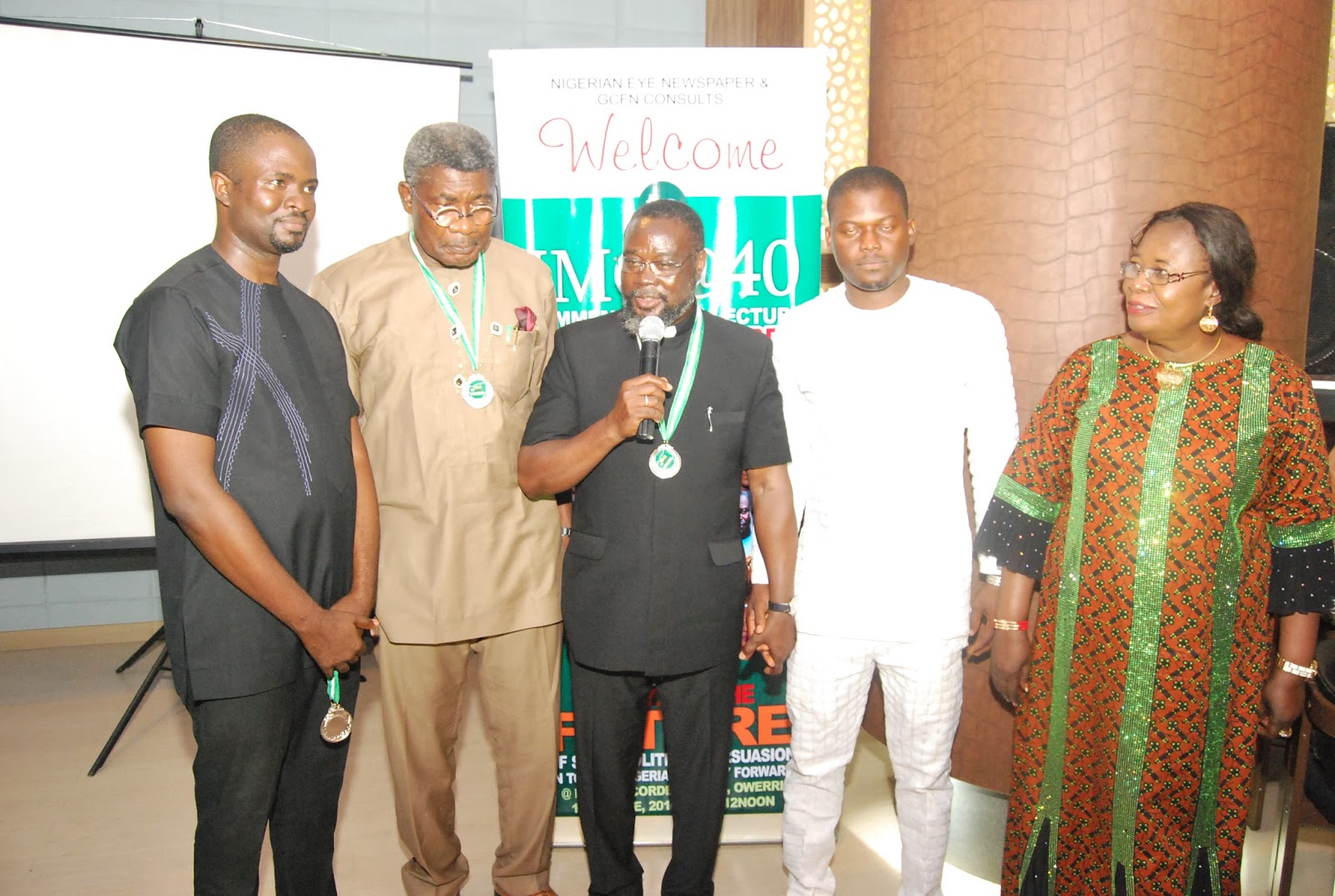
Iyke Anyanwu – publisher Arise Afrika/ Gcfn Consult, Prof BEB, Prof Philp Ogbonna, Cookie & Prof (Mrs) Adaobi Obasi Ag Vice Chancellor Imo State University.

2.0 INTRODUCTION
2.1 Ala Igbo
LocationIgboland.png
Presently Ndi Igbo are a sub-Saharan African people numbering up to 40 millions in the territory that is currently called the South East of Nigeria. Ala Igbo comprises the area occupied by the five South eastern states of Nigeria: Abia, Anambra, Ebonyi, Enugu and Imo. There are also Igbos that are autochthonous/ indigenous in Akwa Ibom, Benue, Cross River, Edo, Delta, Kogi, and Rivers states of Nigeria. The term ‘South East’ is a political designation. The South Eastern States of Nigeria are referred to as Igbo heartland. Those who naturally inhabit the areas just described are called ndi Igbo.  A person from that area is called onye Igbo.
2.2 Igbo political system
Ndi Igbo evolved from a political system that was non-centralized, participatory and extremely democratic. Our socio-political behaviour idealizes egalitarianism and no personalized leadership. Members of the Igbo society \”allowed their daily lives to be governed and guided\” by such socio-political concepts and arrangement. And \”their strong belief in the supreme deity they called Chukwugave remarkable religious colour to the life and work of every Igbo.
The republican and pacifistic nature of the Igbo society did not make for class domination, institutionalized politics and exploitation. That the Igbo did not build regional political empire like the Yoruba and Hausa – Fulani was not weakness. It is our socio-political nature not to build any empire or region by force. For instance, Ndi Igbo had overwhelming demographic advantage over their neighbours to annex them and anchor the \”Igbo Empire\” on the Atlantic coast having played significant part during the Old Atlantic System in the Bight of Benin and Bight of Biafra. In addition, even though the Aro became a regional force through their commercial exploits and had military might of the mercenaries, \”but they never attempted to use force to build an empire or powerful centralized political structure. This points to the pacifistic nature of the Igbo\”.
Again, our political behavioural pattern clearly departs from that of the Yoruba and Hausa-Fulani (whose kingdoms and empires originated from conquest states established by political elites, which originated from societies outside those they ruled and exploited). In addition, any attempt by any group or persons to compel, and or emasculate Igbo society to personalized leadership has not and cannot succeed. This is because Igbo political culture is basically that in which every individual and every social segment expects to be involved (directly or indirectly) in the construction of his or its own destiny. “The present trend by which certain persons make themselves Igbo leaders at Pan – Igbo levels without any regard for the principles of delegation from below and of fair representation” has not worked and will not work to produce continued political succession and capacity building of Ndi Igbo.
Ndi Igbo cannot hope to solve Igbo socio-political problems, including political succession and capacity building \”with the tradition that is of the children of Oduduwa and the people of Kasar Hausa\”. The solution lies with us, the Igbo society. It needs our conscious and dedicated commitment to engineer the socio-political and leadership structure, taking into consideration the enabling and hindering socio-cultural and political factors of the Igbo. This mean that we need to go back to the socio-political drawing board of the Igbo and begin to construct and develop \”a Pan-Igbo organization (not a political party) capable of managing their (Igbo) internal affairs, as well as capable of staking out and effectively promoting Igbo interests and welfare in Nigeria and world affairs\”,
Fortunately, the structure, the nature and the egalitarian social behaviour of the Igbo socio-political framework has great qualities and enabling advantages that can be socially and politically engineered to create a very strong system of political succession and capacity building, using the Pan-Igbo organization as spring-board. Pan-Igbo Assembly must be based on the two basic principles of the Igbo socio-political culture and practice: delegation and fair representation, taking consideration of the traditional political class (traditional rulers), intellectual class, the business/economic elites and women. The youths have a role to play in the assembly.
Socio-political behavioural evolution and history show that any Pan-Igbo association or organization that seeks to speak for on behalf or represent Ndi Igbo must be not be self-appointed but derive its mandate from the people. Sustained political capacity building for the Igbo nation in this 21st century requires serious, concerted and continued socio-political and cultural organizational structuring and re-structuring to enable us succeed in the politics of contemporary Nigeria and Africa.
3.0 FUNDAMENTAL VIRTUES OF NDI IGBO
A virtue is a trait or quality deemed to be morally good and thus is valued as a foundation of principle and good moral being. Igbo virtues are characteristics valued as promoting our collective and individual greatness. The opposite of virtue is vice
Ndi Igbo,according to Okwara (2014) are people who take pride in industry and upright achievement.  “It is this intrinsic characteristic of ndi Igbo that accounts for the high rate of development in spite of the absence of the dividends of governance when compared to other parts of Nigeria.  Ndi Igbo are people who have so conquered fear that nowhere you go and you do not find an Igbo man is not worth visiting. Hear how Ezeala (1992) summarized Ndi Igbo:
“The Igbos have become models of industry and success through hard work. However, their success so achieved has generated envy, greed, rancour, bitterness, animosity and hatred against them by their neighbours, sometimes culminating in plots and conspiracy against their lives and interests. Thus, their industry, valour and vigour have been factors, not for imitation, but for vilification. Whenever, the Igbos have been attacked their attackers and aggressors have whipped up sentiment against them, emphasising: (1) Their prosperity; (2) Prosperity and material acquisition; (3) fervent pursuit of happiness, and enjoyment of life; (4) The burning desire for personal liberty and freedom.”
Some of the major fundamental virtues that have helped ndi Igbothrough the ages and promoted our collective and individual greatness include: Thrift, Hard work and spirit of adventure, tenacity of purpose, competition, etc
3.1 Thrift , Hard work and spirit of adventure:
Ndi Igbo are associated with thrift, hard work and spirit of adventure (Afigbo, 1974). The success of a man in both communities is judged by his ability to deny himself of certain necessities of life so as to be able to raise the capital to establish himself in business, education, commerce and industry. Of course, such a success also calls for hard work and spirit of adventure. And the measure of such success is mostly measured in terms of the amount of wealth, property, education, money, etc. the man had been able to accumulate. Indeed, Afigbo (1994) noted that:
“It is quite clear that the Igbo saw failure in his world as a terrible calamity, which implied damnation and so did everything possible to avoid it. It is this fear of failure, the drive to succeed here and attain the status of \’Ogaranya\’ (a rich man) which he could carry across to the next world, which helped to account for economic drive of the Igbo man, as for the high score and prestige set all hard work, resourcefulness, foresight and rugged individualism.”
3.2 Tenacity of Purpose
The tenacity ndi Igbo appears to have been ingrained in him right from his infancy. Ndi Igbo do not easily give up in the face of difficulty. Even when challenged by the worst, the Igbo man will affirm that it is all right or that it will be alright. \’Kedu?\’ \’Odinma\’ how is it? It is or it will be all right will always be his reply, in the face of any difficulty. Briefly, Ndi Igbo are highly optimistic, believing at all times that the future will be better. Many analysts seem to believe that this shared optimism of the Igbo man was the most important single factor that made it possible for them to very seriously challenge the combined military might of the Federal Republic of Nigeria and Organization of African Unity countries for over thirty months in a gruesome war of secession called Biafran War.
3.3 Competition
Ndi Igbo are at their best in a situation of strict competition with others. For example, when at the advent of the white man and Whiteman’s economy in Nigeria, the Igbo man came to look at white man\’s education as a competitive venture for entry into the more lucrative, and prestigious sector of the economy, they quickly met up with and maybe overtook their Yoruba neighbours who were the earlier starters in education. To substantiate this point Cohen (1974) has this to say:
“In the 1920s, it was estimated that Yoruba’s had over 40% of the total educated persons in prestige occupation, while Ibos filled only 11% of these valued jobs. In subsequent decades, the percentage of educated Ibos rose drastically and seriously threatened the Yoruba hegemony of professional occupations.
4.0 ETHICAL AND CULTURE VALUES
4.1 Introduction
Whereas culture is ‘‘the customs and beliefs, arts, way of life and social organization of a particular community or group’’ – the totality of the way of life of the people of a particular area or organization, ethics is ‘‘the moral principles that control or influence a person’s behaviour. ‘Societies, organizations and indeed establishments that want to survive and grow, draw their code of ethics, a system of moral principles or rules of behaviour, which members and operators are expected to comply with in their day to day activities and in their inter-personal and intra-personal relationships.
                                                            
It clear from these explanations that the way we think and behave or react to those commonly cherished ways of life (ethical and cultural values) impacts on the type and quality leadership we have, consequently on the level of socio-economic and political development of the nation.
4.2 Result of the emergence of effective Igbo leaders
The Ndi Igbo evolved from cultural and ethical values that led to the emergence of true, competent, principled, sensitive, compassionate, and spiritually conscious leaders in the 1950s and 1960s, that exhibited excellent qualities anchored on transparency and integrity. This was to the extent that the economy of the Igbos of the Eastern Region in the 1950s and 1960s was the fastest growing economy in West Africa. During the same period, the standard and products of our educational system compared favourably with the educational standards in Europe and America. Hence, from 1960 to 1970, our university was ranked within the first ten in the world. During the same time, Igbo were the best:
  1. Dr Nnamdi Azikiwe, became the  first and last indigenous Governor General of Nigeria, the do Nigerian democracy
  2. Prof. Kenneth Onwuka Dike became the first indigenous Vice Chancellor of Nigerian University, University of Ibadan. He also  established Nigerian Institute of International affairs and National Achieves
  3. Major General Aguiyi Ironsi became  the first Nigeria to be commissioned into the Nigeria Army, the first indigenous Major General of Nigerian Army and the first Military Head of State
  4. The period saw Professors Enyinnaya Nnochiri and Eyo Bassy Edem exported to Makerere University Uganda to be Provost College of Medicine and Deputy Vice Chancellor respectively.
  5. Legal luminaries of Igbo extraction were appointed Honourable Justices  to serve in Ghana, Gambia, Liberia, Sierra Leone , etc
  6. Dr. Abyssian Akweke Nwafor Orizu, became the first Nigerian Senate president
  7. The flamboyant Dr. K. O Mbadiwe, became the first Nigerian Ambassador Plenipotentiary
  8. Prof. Chike Obi, world renounced mathematician
  9. Sir.Louis Mbanefo, became the first Igbo lawyer
  10. General Chukwuemeka Odumegwu Ojukwu, was the first African  University graduate to enlist in the Nigerian Army
  11. Chukwuemeka Ike, became first Nigerian Registrar of the West African Examination Council (WAEC)
  12. Flora Nwapa,was  the first Nigerian female Novelist
  13. Sam Ibiam, alias the “black Magnet” , became the first Nigerian goal keeper, and the first Nigerian goal-keeper to venture abroad
  14. Titus Okere, became the first Nigerian to sign for professional  football in 1952 in UK
  15. Richard Ihetu (Dike Tiger), who demolished Gene Fullmar and set a record yet to be broken by any African in the World of Fame
  16. Chinyere Onyemuche, became the first Nigerian female pilot
  17. Emmanuel Ifeajuna, in 1954 Common Wealth Games,  Canada won gold medal and brought fame to  Nigeria by jumping bare-footed 7th high
  18. Dan Ayiam, was the first Nigerian coach to be contracted by Nigerian Football Association
  19. Chris Udemezue, was the first indigenous coach under whose leadership Nigeria qualified for the first FIFA WORLD Cup tournament
  20. Jaja Nwachukwu, became first Nigerian Minister of Foreign Affairs
  21. Emeka Anyaoku, was the first Africa to be Secretary to the Common Wealth
Our founding Igbo fathers enunciated far-sighted initiatives that served our people well not just in the field of agriculture but also in the larger area of human development.” Today we remember them for their great leadership qualities and sustainable development both human and materials. For instance, the numerous path-breaking initiatives put in place by the administration of Dr. Michael Okpara in the eastern region was very outstanding. Indeed, one can be safely argued that the Farm Settlement Schemes in the then Eastern Region represented landmark initiatives in institutional mentoring, which promoted the infusion of fresh and vibrant blood into the region\’s agricultural sector.
This work has gone on “this excursion into the past not merely to romanticize the proverbial \”good old days\” but more importantly to call painful attention to the road not taken in our subsequent quest for national development. The attributes that made the successes recorded in the 1950s and 1960s possible were in many cases both structural and highly personalized. However, the common denominator appeared to have been the calibre and competence of the leadership that our Region and country had then.
It has been argued with some merit, that if only we recreate our cherished ethical and cultural values and return to the standards and achievements of those good old years, that would be a tremendous breakthrough indeed. And this can be achieved if we consciously and strategically begin to inculcate through mentoring these our cherished cultural and ethical values and milieu that produced our founding fathers
If we look around and see what is happening to us in the South Eastern Nigeria, you will quite agree with me that we desperately need to develop emerging true, competent and ethical and inspirational leaders that will buy into this attitudinal transformation anchored on transparency and integrity. With such true leaders, we can solve the socioeconomic and political questions in the Region and we can definitely manage the abundant God-given natural resources and easily evolve into being a member of league of developed nations of the world. I wish to submit that lack of adequate preparation for leadership, especially in public life, is a critical missing link in our search for solutions.
It is important to note that ethical and inspirational leadership begins in the spirit of a person. When the spirit of leadership comes alive, it produces an attitude that separates the leader from the follower.’’ If we are to produce ethical, and inspirational leaders in the South East, we need to change the present mental/attitudinal disposition (which are inimical to the socioeconomic and political growth and development of the Region and nation) of our emerging leaders. There is therefore need for us to groom emerging leaders from cradle to dramatically change their mental/attitudinal dispositions so that they begin to uphold our cultural and ethical values that will cause them to exhibit high level of transparency and integrity in all activities. And this is the change we need.
The way forward is for us to begin to develop good leadership from the cradle based on our positive cultural and ethical values anchored on our Christian/religious faith. This no doubt will create a strong foundation and framework for Regional and national transformation. This leadership challenge is especially important at this point in our national life, when our country is passing through arguably the greatest existential threat to its corporate survival since the Biafran/Nigerian Civil War.
4.2 Serious infringements on our ethical and cultural values in the southeast
Unfortunately, over the years, we have observed with embarrassment that there have been very serious infringements and in some cases outright negation of these beliefs and ways of life in the Region and country. ‘Selfishness, greed and avarice, have over the years caused us the loss of these cherished values’ and the aftermath if this is failed leadership. Some of these our cherished ethical and cultural values that have witnessed very serious infringements and in some cases outright negation include:
  • Being our Brothers Keepers (bonds of kinship)
  • Condemnation of unethical attitudes or behaviour
  • Dignity of labour and celebration of genuine achievements – Respect for excellence and contempt for laziness and mediocrity
  • Dignity of man
  • Respect of constituted authority and justice
  • Sacredness of life
(a) Being our Brothers- Keeper: This is kinship system anchored on the concept of extended family system. “This system ensures that there is helping hand to every member of the bigger family and has remained the back bone of the successes recorded within the Igbo community. Under the kinship system, family members rejoice with kins in their prosperity and mourned with them when troubles struck. In this system, there was no envy or unhealthy rivalry. Unfortunately, these days, cultural and ethical values are fast phasing away and being replaced by me and my family syndrome. What we have now is mainly ‘the attitude or behavioural tendencies to appropriate to ourselves and our families almost all the resources of the community or establishments whenever we find ourselves in position to do so. This is the root of corruption in our system’’.
(b) Condemnation of unethical behaviours and attitude: We were brought from a society that condemned unethical and immoral behaviours. Even sanctions ranging from banishment to fine existed to be a deterrent. These were applied without fear or favour. The elders stay in judgement to determine the level of culpability and the appropriate sanctions. ‘‘With the establishment of the English judicial and penal system, most cases are now taken to the courts. The fact that some of these cases stay too long in the court, has given rise to some people taking actions they consider appropriate – though unacceptable by our legal system, – to seek redress and resolution of their problem. Unfortunately, this process appears not to bring forth quick solutions to their problems; sometimes the processes are aborted. People now get frustrated”.
(c) Dignity of labour andCelebration of Genuine Achievements
“Our people believed that “aka aja aja, ne-ebute onu mmanu mmanu”. ‘‘Children were, from the early years, made to accompany their parents to their farms to work or to participate in their different business ventures. Idleness was abhorred.’’.  These days, begging that was considered a disgraceful act is now accepted to the extent that parents now turn their children into the streets to beg for alms. The youths now concern themselves with how to make money without labouring for it. ‘‘This has led to so many anti-social behaviours amongst our people’’.
We emerged from cultural values that celebrated excellence and genuine achievements. Then title/positions were given to those who had achieved. Chieftaincy titles were then given on merit. Then ‘‘merit was considered not only on how much money you are able to dole out, but also on the ground that the source of wealth is known and can be traced to achievement in chosen careers/honest business; contributions to the  immediate or larger society.’’ Now with that ‘‘the bastardization of the traditional institution of Ezeship (the custodian of our culture and tradition) and the entry [of some] people with questionable moral and ethical credentials, chieftaincy titles became ten for a kobo and can be sold to anyone who cared for it. This should not imply that some Ezes and indeed some recipients of chieftaincy titles today do not merit them. This development is most unfortunate and has done incalculable harm on the psyche and perception of our people.’’
(d) Dignity of Man: A true Igbo man believes that he has dignity which must be protected and must do everything to protect his honour or dignity. “The Igbo saying that “ImevǪ nwa Ǫgaranya, ka ogbugbu ya” is world view on how we value our dignity. Unfortunately, these days, we see opponents/competitors in all facets of life tarnishing or reducing the dignity of follow man through blackmail or lies to score unethical points or have advantage over the other person for political reasons”.
(e) Respect for constituted authorities and justice: Before now we had well structured and hierarchy of authority was well known and respected. Leadership of those days appreciated this ethical value and ‘‘hence acted in a way that made the society repose confidence in them.’’ These days things seem to have changed for worse,; our leadership (some elders, traditional rulers and even religious leaders) ‘have not completely reciprocated this confidence reposed on them [by the society] in their actions and pronouncement’. They now give judgement only to the rich and mighty and the impact is the eroding of the confidence, respect and standing of their authorities. ‘‘A situation where those who are charged with the responsibility of maintaining law and order in the society turn out to be those breaking them does not augur well for the socio-economic development of the society and nation’’.
‘‘Progress, development and harmony can only thrive in a society, where there is respect for the rule of law; where there is justice and it is administered to all without fear or favour; where all are seen to be equal before the law and where double standards or different strokes for different people are not applicable; where things are done following laid down procedures and processes. These days, justice, fair play and equity, in some cases are old school. Now ‘‘the mighty use their positions to oppress and dictate to the poor and the lowly. Political powers are no longer used for service but for oppression of perceived or imagined opponents or detractors; by the rich and powerful. These days ‘‘might and wealth determine who gets justice or not. In today’s society, this unethical attitude is one of the major bane of our society’’ that has led to failed leadership in the country”.
(h) Sacredness of life:From time immemorial in the Igbo cultural and ethical milieu, ‘‘life was considered sacred and hence it was an abomination for one to kill his neighbour or any person at all, except of course only when in self defence. As such a lot of respect was attached to the human person, dead or alive and issues like abortion, prostitution, kidnapping, human trafficking were regarded as anti-cultural; so also was the concept of slave and slave trading’’. Unfortunately we observe today that ‘‘because of changes in our metal and attitudinal disposition and the relegation to the background of our cultural values, prostitution by the young and the old, child kidnapping and the attendant demand for ransom; the killing of political opponents by hired assassins, abortion of pregnancies etc are today rationalized under one reason or the other”.
4.3 Re-awakening of a strong and sustainable ethical and cultural values in our leaders
(a) Definition
There are several definitions of leadership and for the purpose of this lecture; we will limit our definition to that of Dr. Paul Hersey, who defined leadership as \”working with and through others to achieve objectives\”. Leadership is a trusted privilege given by followers. Given the Dr Hersey’s definition, anyone in a position whose achievement requires support from others can play the role of a leader. This definition supports the philosophy of \”leadership at all levels,\” which is so critical in today\’s world of knowledge workers.
Commonly asked Questions n Leadership
  • Is a leader defined by a person’s title? 
  • Is a professional required to have ten or fifteen years of experience with multiple promotions in order to be viewed as a leader? 
  • Does a leader always have a higher rank?
  • Are we influenced more by nature or nurture?
  • Are great leaders born or made?
Life offers each of us opportunities to be a leader. Leadership is not reserved for those who hold a title or a lucrative position. Leadership can be demonstrated by anyone in any capacity in which they serve. We need leadership in our homes, our churches, our jobs, and everywhere in between.
(b) Leadership failure
Unfortunately, our greatest challenge today is that of a leadership vacuum. Today,:
  • we hear of leaders having sexual escapades.
  • We hear of business magnates falling by the dozens to corruption.
  • We see local and national leaders and their cabinet members being tried by their own government for stealing and other financial misconduct.
  • We learn of priests abusing and misusing their authority and positions in order to take advantage of those whom they were entrusted to care for.
  • We hear and see families dissolved and or abandoned by their leaders. These are leadership failures.
Moral defects; abuse of power, privilege, and trust; misuse of resources; corruption; and hypocrisy have become associated with our leadership today perhaps more than at any other time in history.
With these failures in our society and leadership, there is an urgent need for a re-awakening of a strong and sustainable ethical and cultural values and structure that can grow and nurture a robust purpose-driven leadership. There is the need for recruitment process where our Region’s future leaders are mentored for governance excellence in all segments of the society. The need has come for all true citizens of the Region to collaborate urgently and ensure that Eastern Region remains on the path of sustainable growth and development.
We must as a Region make concerted efforts towards reorienting our mental attitude and behaviours. It is possible that we can transform our present attitudes, values system and attitudinal disposition towards building as strong, viable and culturally sensitive emerging leaders and Region.
(c) We can change our habits
Since the components of habits (knowledge, skill and desire) are learned rather than inherited, our habits (attitudes, values system and attitudinal disposition) are our second nature. Thus, we can cause an orientation make or break our mental/attitudinal dispositions through mentoring leaders so that we begin to uphold our cultural and ethical values that will cause us to produce emerging leaders that will exhibit high level of transparency and integrity in all activities – being ethical and inspirational leaders.
5.0 WHAT NEXT BECAUSE TIME IS RUNNING OUT ON US
Ladies and gentle men, some of us may wonder why I am speaking in this manner today. The truth is that time may be running out. “We should all be aware that the rampant and pervasive unemployment among our youth is a danger to all of us. Daily, we see manifestations of the fact that our youth are losing patience and losing focus. From terrorism and kidnapping in the north, to rampant armed robbery and kidnapping in the east and west; from militancy in the Niger Delta to the \”Area Boy\” syndrome in the west, what we have on our hands today are young people banging at the door, seeking to enter. We could choose to let them in peacefully through a well thought out process of transformational mentoring or we could watch them break down the door. The choice really is ours, but as the saying goes, the rich cannot sleep if the poor are hungry.”
The modest proposal for transformational mentoring we think that help our Region and Nigeria come out from this quagmire, consequently stimulating the future growth of our Region and country is to effectively use the apex institutions.
Three apex institutions left in Nigeria now to cause Transformational mentorship in leadership are the Religious organizations, educational institutions and the family. Especially, the religious organizations, because of the fact that great majority of the members of other institutions in the Region are in one religious organization or the other. In this part of the world, the Church has great role to play in the transformational mentorship of our up coming leaders. Religion is the opium of life, and the Church should capitalize on this advantage to begin the process of transformational mentorship of our leadership in their congregations.
(i) Christians in transformational mentorship
Although “mentoring” doesn’t appear in the Bible, Scripture does give us numerous examples of mentoring. Moses was mentored in the house of Pharaoh and by his father-in-law Jethro, first as son-in-law and then as a leader (Exodus 18) and Moses mentored Joshua and Caleb. The mentoring relationship between Eli and Samuel prepared Samuel for the tasks and responsibilities (1 Samuel 1-4). Jesus mentored His disciples (Luke 9), and both Barnabas and Paul excelled in mentoring (Acts 9-15), and Elijah mentored Elisha and he got double anointing.

In fact, the Christian church has historically valued mentoring relationships and the part they play in developing the faith of the next generation. For instance, Christian women in particular have mentoring functions to be inherent in the mandate of Titus 2:3-5:Older women likewise are to be reverent in behaviour, not slanderers or slaves to much wine. They are to teach what is good, and so train the young women to love their husbands and children, to be self-controlled, pure, working at home, kind, and submissive to their own husbands, that the word of God may not be reviled”.

And for men, Titus 2:6-8: stated “Likewise, urge the younger men to be self-controlled. Show yourself in all respects to be a model of good works, and in your teaching show integrity, dignity, and sound speech that cannot be condemned, so that an opponent may be put to shame, having nothing evil to say about us.”

Iron sharpens iron, and one man sharpens another says the Scripture (Proverbs 27, 17). God knows the importance of transformational mentorship in leadership he commanded the children of Israel to mentor their children when He said in Deuteronomy 6:6-9,“Hear, O Israel …And these words that I command you today shall be on your heart. You shall teach them diligently to your children, and shall talk of them when you sit in your house, and when you walk by the way, and when you lie down, and when you rise. You shall bind them as a sign on your hand, and they shall be as frontlets between your eyes.”

(ii) Transformational mentorship in educational institutions: The school mentoring programs have been touted as solutions to various problems affecting youth, such as increased drug and alcohol use, teenage pregnancy, poor academic performance, low self-esteem, and increase in juvenile crime. Such planned mentoring occurs through structured programs in which adults mentors, especially teachers and youths are selected and matched through formal processes. The purpose of the mentoring programs is to provide youths with assistance and guidance to enable them to grow into responsible adults and leaders. Overwhelming evidence have shown that students and youths who had consistent contact with an adult mentors did better on the composite, reading, and math portions of an achievement test and in leadership. The schools should play serious role in the transformational mentorship of our up coming leaders. Such school-based mentoring will support the religious mentoring, consequently helping our generation to develop good leadership from the cradle thereby creating a framework for national transformation.
(iii) The family and transformational mentorship in leadership: It is at the family level that the foundation of transformational mentorship is laid. It is at this level that children are mentored to appreciate fundamental principles that govern human dimension, which actually establish the strong foundation for transformational leadership in children. These human principles are guidelines for human conduct that are proven to have enduring, permanent value. These principles are fundamental, and they are natural laws which govern the human dimension. Examples of principles in human dimension include:
§  fairness,
§  integrity and honesty,
§  service, and
§  quality or excellence
§  The law of harvest: We reap what we sow. “Sow a thought, reap an action; Sow an action, reap a habit; Sow a habit, reap a character; Sow a character, reap a destiny.
§  Abundant mentality or win-win mentality
§  Synergy is the habit of creative teamwork or team building. We can’t do it alone. Synergy occurs when minds stimulate each other and ideas call forth ideas.
§  The humility and reverence to recognize personal limitations and to appreciate the rich resources available through interaction with the hearts and minds of other humans.
Families should take their responsibilities of mentoring the children very serious so that we can produce the leadership we desire in the country.
Chairman, Ladies and gentlemen, let’s nurture and produce children who are going to emerge as leaders that respect and sustain our cherished cultural and ethical values. This is the way forward to our socio-political quagmire, consequently stimulating the future growth of our Region and country. This is the change we need.
Distinguished Ladies and Gentlemen, all that remains for me is to thank the organizes of this meeting for inviting me to contribute and to thank all for your attention.
Professor Bertram Ekejiuba Bright NWOKE
Umuariam Obowo LGA


[1] Guest Lecture presented at IMO AT 40 organized by GCFN CONSULT – Publishers of Arise Afrika, Nigerian Eye Newspapers  to Analyse the Future of South East Socio-political Persuasion in Today’s Nigeria and the Way Forward at Concord Hotel Owerri, June 18, 2016

visit: www.gcfnconsult.org.ng 
Call us for an initial no obligation meeting 08037512288 – We are into Events planning & management.

MOMENT OF DISCOVERY


MEN BEING IN ALIGNMENT WITH GOD BECAUSE OF THEIR RESPONSIBILITES AS MINISTERS, HUSBANDS, FATHERS-  By Victor Nwaorgu
As a prelude into a proper exposition of the above subject, it has become imperative to know what the topic really signifies, to be in alignment with God in essence means maintaining the same balance with his spirit. Alignment has to do with one’s connection with God.  It goes beyond one’s behavior.
The almighty cares so much about it, he wants us his children to be in alignment with his will once we are united with the lord, we will adhere to all his instruction even when he requests from us to do the impossible.  
 When we realize our spiritual alignment, it will enlarge our life and multiply our effectiveness because it will take away from us all sense of doubt, feelings of inability to buffet the storms of life it will give us a new meaning of living.  Life will take on a whole new meaning, when we live in constant realization of our alignment with the lord.  The nearer we are to the lord the greater our strength.  There is no true success in ministry not until we connect with the most high, When we fail in aligning ourselves with the lord we will not be able to do anything.  
Having  been saved  by grace , we are his chosen ones , we live by  the aid  of  the holy spirit, by faith .we  should seek  Gods  guidance and direction through his word   to perform well in the  various ministries where the lord has called us.  He has appointed teachers, preachers, prophets, singers, and evangelists. Without this connection, we simply drift away from God’s plan and purpose for us in life.
Many a time, we have all been guilty of being overly confident in our own abilities.  Our insensitivity  at  some points  overinflate  our  sense  of self – assurance  thus creating  a bridge  in  the flow of communication. We no longer seek to hear from God before any decision. In other cases many of us start in the right way, always seeking the guidance of the lord, but as we begin to develop a level of  comfort  that  the lord  is with us  we start  paying  less   attention  to  the guidance  of the  lord . we must  always  remember  who  it is  that  is  strong and mighty  –He  who makes  us  mighty , and seek his acknowledgement  always. 
Every  married  man has  some specific  responsibilities to play in the life  of  his wife .remember , marriage is an institution  created  by God and  he  sets his rules. A man is to love his wife, when the scripture talks about love; it talks about sacrifice that you make for the betterment of someone else. 

 
You can only measure love by your level of sacrifice and not by your satisfaction.  To say that a man loves his wife is to talk about the sacrifice that he makes for her. Husbands love your wives even as also Christ loved the assembly and gave up himself for it”. (Ephesians 5: 25). To talk about love is to talk about a cross. To talk about love is to talk about a savior.  We have a savior in Christ and our wives ought to have a savior in us. We have a deliverer in Christ and our mates ought to have a deliverer in us.   When you talk of loving your wife, you talk about carrying a cross.  Jesus Christ did not die for us because we are loveable, Jesus died to make us loveable.
A man does not love his wife because she deserves to be loved; a man loves his wife in order to change her into someone loveable.   The scripture talked about Jacob s love for Rachel, so much that he worked for fourteen years in order to gain permission to marry her from her father (Genesis 29).  It is a hard price to pay, but a price of true love.  “But God commanded his love to us, that while we where yet sinners, Christ died for us”. (Romans 5:8).   Guess what?  If you love your wife you have to sanctify her, you are to take her from the level where she is to the level where you want her to be.
When she shows you her problem, you are to fix it.  You are the god of your home, what Jesus is to the church, you are to be to your wife.   Husbands should love their wives as their own bodies. Christ gave himself to his church. Just as the man works out to make his body look good, he is to work his wife out to look good as well. Make sure that she is strong, fulfilled, provided for and satisfied. The father is the head of the home. The home is where the physical, emotional and spiritual grace of a child is nurtured.
 A father who is aligned with God has the ability to call forth the grace of God through Love, care, provision, guidance and advice.  A godly Father upholds the spiritual alter of the family, He sharpens and guides the child towards reaching the vision and purpose of his existence.    And now words to you parents don’t keep on scolding and nagging your children making them angry and resentful rather bring them up with the loving discipline the lord himself approves with suggestion and godly advice. (Eph 6:4). 
The greatest gift a father can give to the child is love. Just like God our heavenly father loves us his children. A child who has the conviction  that he has a father  who loves  him will always  put  his trust in his father simply put , when affection is shown to a child it brings out the best in the child, the child will have the consciousness that he has  a shoulder  to cry and lean on , he has someone he can call a friend  who  he can  tell his fears , share his vision and aspirations with and also confide in.   Sure the rod of correction should not be spared but a father should also correct in love.
God is a merciful father who will always chastise and correct us in love whenever we go astray.  “If a child asks his father for bread, will he be given a stone? If he asks for dish will he be given snake?  Of course not! And if you men know how to give good gift to your children, won’t your heavenly father even more certainly give good gifts to those who ask him for them.” (Matthew 7:9-11).  
 Just like God, the primary function of a father is to provide for his children s need, Needs vary according to stages the need of your child when he is an infant may not be the same as when he is an adult. It can be physical, emotional, or a spiritual need.
 A father should brace up to this task. The children are precious gifts which the lord has entrusted in your custody.  As a father you are to provide and take care of their everyday needs because surely as caretakers, one day we will stand to give account on how well we have been able to bring up these children in the fear of God.    
Victor Nwaorgu is a motivational speaker and prolific writer, with a mark of distinction. He makes himself relevant everywhere he goes. He is mandated with a mission to positively impact in the lives of many in this generation. He has a global vision geared towards making positive impact in the lives of youths all over the world. Victor has held various leadership positions within and outside the church.  He holds a degree in Business Management from the Prestigious University of Hertfordshire United Kingdom and a first degree in Political science from Madonna University Nigeria. He is currently the Director of Media and Publicity at GCFN CONSULT and married to Promise Nwaorgu